
The Lineage
Twenty-five centuries of men looking at other men, deciding it was worth recording. This page is NUBRONZE’s own record of that homoerotic art history — NUBRONZE didn’t invent the impulse, it inherited it, and this is where the inheritance gets traced properly: from the first sculptors who decided a discus-thrower’s body deserved marble, through the photographers and filmmakers who kept the same argument going once cameras replaced chisels, up to what NUBRONZE itself is doing with it now.
Before Photography
Photography wasn’t the beginning of any of this — it’s a relatively late chapter in a much older argument. The Male Body as Erotic Subject: A History Before Photography covers the twenty-five centuries before a camera ever got involved: the Greek kalos and the specific, codified body type it described; Antinoüs, deified by grief into hundreds of surviving nude statues; the Roman convention of heroic nudity, real emperors sculpted with the bodies of gods; Michelangelo and the Sistine ceiling’s Ignudi; Saint Sebastian, painted nearly nude and pierced by four centuries of artists who kept finding reasons to return to him; and Thomas Eakins, whose 1885 Swimming closes the gap between painting and photography almost entirely. Everything that follows on this page assumes that history as its foundation, not its backstory.
The Photographers
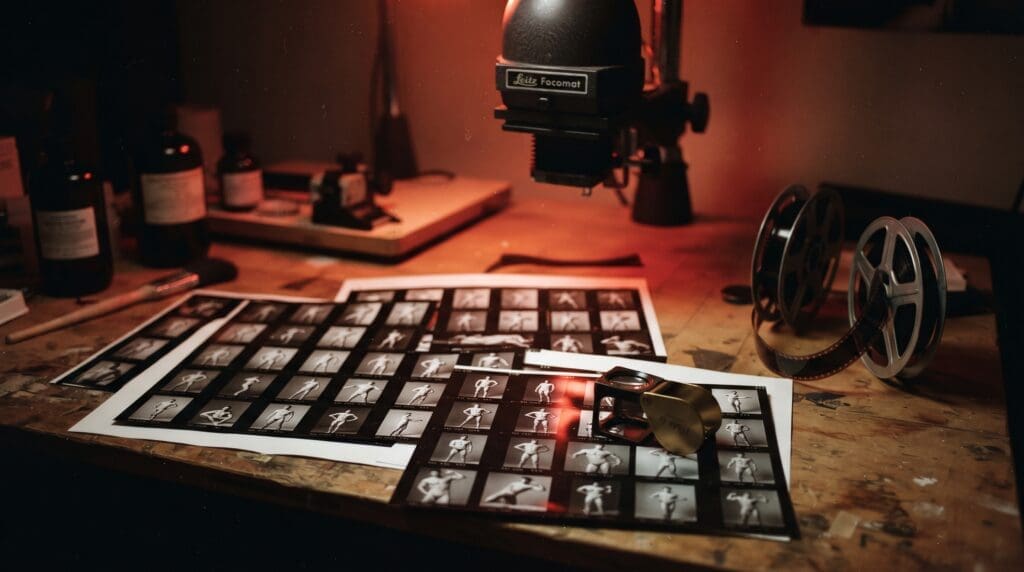
Photography picked up exactly where sculpture and painting left off, carrying this homoerotic art history forward with considerably less plausible deniability than either medium allowed itself. Several photographers already have a full page of their own on NUBRONZE, each covering different decades and different registers of the same underlying argument.
Robert Mapplethorpe brought total formal control to explicit content — the X Portfolio’s bondage and leather scenes shot with the same cold precision as his flower photography, a body of work confrontational enough to end up in a criminal obscenity trial. Herb Ritts took a gentler, more commercial path to nearly the same place, embedding real homoerotic desire inside mainstream fashion and celebrity photography that never had to announce itself outright. David LaChapelle pushed the whole tradition toward theatrical maximalism, discovered by Andy Warhol as a teenager and eventually folding explicit male desire directly into his fine-art tableaux, religious and consumerist imagery collapsed into the same frame.
Other names belong in this same lineage, still awaiting their own pages: Bob Mizer and the Athletic Model Guild, George Platt Lynes, James Bidgood, Herbert List, Tom Bianchi, Bruce Weber, Pierre et Gilles, Paul Freeman, François Rousseau, Mathias Vriens, Michael Stokes. NUBRONZE will keep adding to this list as this homoerotic art history keeps expanding on the site.
The Filmmakers & Writers
Cinema’s version of this history has a tutelary figure standing slightly apart from the rest: Jean Genet, a convicted thief who wrote his way out of a life sentence and directed exactly one film, Un Chant d’Amour — twenty-six silent minutes that fused crime, prison, and desire into a single unbroken argument, an influence every European filmmaker on this list either studied directly or absorbed secondhand.
Several filmmakers already have their own page. Andy Warhol pointed his fixed, unblinking Factory camera at male sexuality as plainly as he pointed it at a soup can, and shot an enormous private Polaroid archive of explicit male nudes alongside the pop art that made him famous. Pier Paolo Pasolini insisted on real, unglamorous bodies over trained performance, right up through Salò, released weeks before his still-unresolved murder near Ostia. Andrew Haigh built an entire career on the small physical gesture over the dramatic statement, from Weekend through All of Us Strangers. Luca Guadagnino makes desire take its time on screen, tension accumulated through heat and proximity rather than announced through dialogue.
Other names belong here too, still awaiting their own pages: Kenneth Anger, Luchino Visconti, Rainer Werner Fassbinder, Derek Jarman, João Pedro Rodrigues, Marco Berger, Noel Alejandro.
What NUBRONZE Actually Does With All of This
NUBRONZE doesn’t claim to belong on this homoerotic art history yet — that’s not a claim any publication earns by simply existing. What NUBRONZE does claim is a place inside the same argument this entire history has been making for twenty-five centuries: that the male body, desired openly, is worth exactly as much formal seriousness as anything else a camera or a chisel has ever pointed at. The Spartan Bred picks up antiquity’s own vocabulary directly. Epics Uncut does the same across a much wider survey of myth. Taking the Photographer runs on the same relationship-first discipline Mapplethorpe’s own models describe. None of it claims equivalence with the names above. All of it claims descent.
NUBRONZE’s fuller argument about what any of this actually means — the term embodied eroticism, and why it matters that a camera or a generative model can carry the same seriousness a sculptor once did — runs in full on AI & The Gaze. And the same lineage runs, in condensed form, through every issue The Magazine publishes.
Is this history entirely Western?
Largely, yes — the documented tradition runs almost exclusively through Greek, Roman, and European and American figures, which is a real limitation of the historical record itself, not a choice NUBRONZE is making. NUBRONZE's own interest doesn't stop at that boundary, and future coverage will reflect a wider curiosity the surviving canon doesn't always accommodate.
Why does this history start before photography even existed?
Because the male body as an erotic subject didn’t begin with a camera — Greek sculpture, Roman heroic nudity, and Renaissance painting were already having the same argument, in marble and oil, centuries earlier.
Is Jean Genet part of this homoerotic art history as a photographer or a filmmaker?
Neither primarily — he was a novelist first, and directed exactly one film in his life. His literary and cinematic influence on the filmmakers covered here is direct rather than incidental.
Does NUBRONZE consider itself part of this history?
NUBRONZE claims descent from the same argument this homoerotic art history makes — that the male body deserves serious formal attention — without claiming equivalence with any specific figure on this list.
Where does NUBRONZE explain its own artistic position in more depth?
AI & The Gaze covers that in full, including the term embodied eroticism that runs through NUBRONZE’s own practice.