
 The Body of the Palaestra
 The Body of the Palaestra
Greek culture didn’t consider the male body beautiful in some general, all-purpose sense — it had a specific type in mind, and that type was remarkably consistent for centuries. This is the oldest chapter of male nude art history, and it starts with a formula rather than an accident. Nudity itself was simply a given — the word gymnasion, the training ground where all of this played out, means literally “place to be naked,” and Greek men trained, competed, and were sculpted nude as a matter of course, not exhibition. Young, never a mature man; athletic, built by the palaestra rather than posed for it; hairless, smooth in a way the Greeks associated directly with youth rather than grooming. The Discobolus and the Doryphoros — both known today mainly through Roman marble copies of lost Greek bronzes — codified that type into something close to a formula: weight balanced, muscle defined but not exaggerated, the body caught in the instant before or after effort rather than straining through it. Genitals, notably, were kept small and unremarkable by deliberate convention — restraint read as a mark of civilization and self-control, while size was reserved in Greek art for satyrs, fools, and figures of excess. This wasn’t incidental to Greek life. The word kalos — beautiful — got inscribed on pottery next to the names of specific young men, a public declaration of desire that ancient viewers would have read as exactly that. The institution underneath the aesthetic was direct: an older man, the erastes, and a younger one, the eromenos, bound by a relationship that combined mentorship with open erotic desire, considered unremarkable within its proper social bounds.
Antinoüs, Deified
No figure from antiquity demonstrates how far that desire could travel institutionally quite like Antinoüs. A young Bithynian favored by the Roman emperor Hadrian, he drowned in the Nile in 130 CE under circumstances that were never fully explained. Hadrian’s grief was not private. He founded a city at the site of the death, had Antinoüs formally deified, and commissioned or inspired more surviving sculpture of him than of almost any other private individual from the ancient world — hundreds of statues, spread across the empire, all rendering the same face in the same idealized late-Hellenistic style. A striking number of them are fully nude, the emperor’s grief rendered not as a clothed, dignified portrait but as an idealized naked body, following the same convention that had governed athletic and divine sculpture for centuries. A Roman emperor’s erotic devotion to a specific young man became, quite literally, a state religion for a while. Nothing about that survives in the historical record as scandal. It survives as monument — one of the clearest cases male nude art history has to offer of desire granted total institutional cover.
Heroic Nudity, and a Martyr Renaissance Couldn’t Stop Painting
Rome inherited the Greek aesthetic and put it to a use the Greeks never quite intended: real, named, historically verifiable men, sculpted nude in a convention art historians call heroic nudity — a recognizable portrait face on an idealized athletic body, borrowed wholesale from Greek precedent to associate a living or recently dead ruler with divine and heroic status. Augustus and Hadrian both received this treatment, and this exact convention is one of the strangest chapters any survey of male nude art history has to account for — actual political leaders, sculpted the way athletes and gods were. It’s worth noting how familiar that specific trick — a real, recognizable identity fused onto an invented, idealized body — has become again, this time through an entirely different technology. The Renaissance revived the same appetite through Michelangelo, whose David, Bacchus, and the Ignudi surrounding the Sistine ceiling gave this male nude art history a sacred, publicly sanctioned context centuries of Christian art had otherwise foreclosed. And no single religious subject absorbed more of that suppressed charge than Saint Sebastian — a martyr traditionally shown young, nearly nude, and pierced with arrows in a pose that reads, especially in Guido Reni’s several versions, as considerably closer to ecstasy than agony. Painters kept returning to him for four centuries. It’s not hard to see why.
Eakins, and the Moment Painting Started Looking Like Photography
 Eakins, and the Moment Painting Started Looking Like Photography
By the late nineteenth century, the tradition had drifted from myth and martyrdom toward something plainer: real men, observed rather than idealized. Thomas Eakins’ The Swimming Hole (1885) shows a group of nude men at a Pennsylvania swimming hole, arranged with a compositional care that borrows directly from classical precedent — one figure reclines almost exactly like a Greek river god — while everything else about the painting insists on the ordinary and the actual. Eakins had studied photography seriously and used it constantly in preparing his paintings; the men in The Swimming Hole were real students and friends, photographed by Eakins before he painted them. The distance between myth and camera had almost closed entirely.
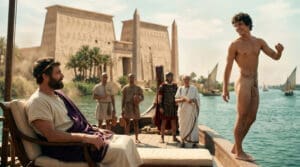
That distance closed completely once photography itself took over the job painting and sculpture had done for twenty-five centuries. NUBRONZE’s own Lineage traces exactly that handoff — Robert Mapplethorpe treating the male nude with the same sculptural formalism antiquity applied to marble, Herb Ritts shooting bodies in hard sunlight the way a Greek sculptor might have imagined them lit, David LaChapelle inheriting the theatrical, myth-scaled excess of Baroque martyrdom painting and pointing it at pop culture instead. Epics Uncut closes the loop more directly still — a series built entirely on giving antiquity’s own myths the nudity and desire this male nude art history shows they always actually implied. The Spartan Bred picks up the same premise that opened this page — nudity as simply given, the way it was on any real palaestra floor, never built toward as a reveal. And The Favourite runs an odd, direct echo of heroic nudity itself: an anonymous body standing in for power across forty different settings, exactly the trick Augustus and Hadrian’s sculptors were already turning two thousand years earlier.