
Herb Ritts: The Photographer Who Made the Male Body Look Like Sculpture
An Accidental Career
The Photo That Started Everything
Herb Ritts grew up in Los Angeles, the son of a furniture manufacturer, with no formal photography training at all. The story that launches every account of his career is almost too tidy to be true, and it happens to be accurate: in 1978, he took a friend named Richard Gere to a gas station in the California desert on a whim and shot a few rolls of film, one arm slung over an oil drum, shirt half-open. Gere’s career took off within the year, the photo ran everywhere, and Ritts suddenly had a career he’d never trained for. He was in his mid-twenties, working a day job, with nothing resembling a photography portfolio the week before that shoot happened.
From Accident to Institution
What followed for Herb Ritts was two decades at the center of American fashion and celebrity photography — Vogue, Vanity Fair, Rolling Stone, campaigns for Calvin Klein and Gap, portraits of Madonna, Michael Jackson, and dozens of other major figures of the era. Ritts became, alongside Bruce Weber and a handful of others, one of the photographers who defined how American celebrity culture actually looked through the 1980s and 90s: sun-drenched, black and white or high-contrast color, bodies treated with an athletic, sculptural seriousness that mainstream fashion photography rarely allowed itself before him. He also directed music videos during the same period, including Madonna’s “Cherish,” carrying the same visual sensibility from still photography into motion.
A Body Read as Marble
The Classical Instinct
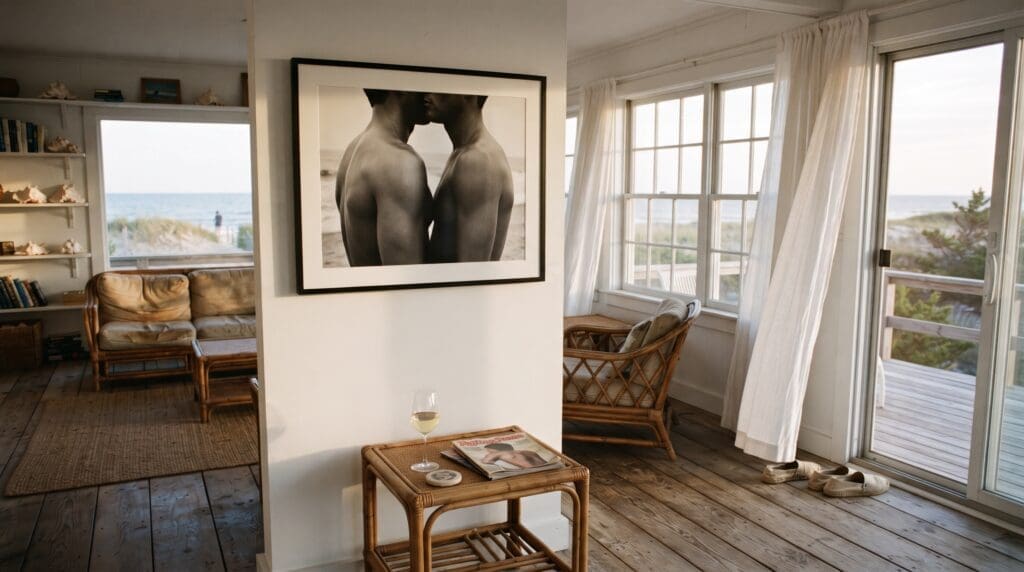
What set Ritts apart from most fashion photographers of his era was a persistent classical instinct — bodies lit and posed to recall Greek and Roman statuary, hard California sunlight standing in for a sculptor’s studio. His most famous image, Fred with Tires (1984), shows a bodybuilder’s torso and a stack of truck tires reduced to pure geometric form, muscle and rubber photographed with the same graphic clarity. Athletes, dancers, and bodybuilders appear constantly throughout his catalogue, always treated less as individuals than as studies in form — the same instinct that drove classical sculpture, applied to a Hasselblad instead of a chisel. Outdoor natural light was central to that instinct — Ritts rarely worked in a fully controlled studio, preferring hard sun and open landscape to soften nothing.
Homoeroticism That Never Had to Announce Itself
Where Mapplethorpe’s most explicit work forced a direct confrontation with what a camera was allowed to show, Ritts operated almost entirely within commercial fashion photography and still carried an unmistakable homoerotic sensibility through it — desire embedded in composition and lighting rather than declared outright. That subtlety let his work reach an audience Mapplethorpe’s never fully could, mainstream magazine racks rather than gallery walls, without the sensibility itself ever really being in question to anyone paying attention. A generation of readers who never saw an X Portfolio print absorbed the same essential desire anyway, packaged inside a Calvin Klein campaign or a Vanity Fair cover.
Where That Same Light Still Falls
Ritts died of complications from HIV/AIDS in 2002, at fifty, and the sculptural, sun-drenched treatment of the male body he spent two decades perfecting didn’t really have a direct successor in mainstream fashion photography after him — the industry moved toward a flatter, more clinical style of celebrity image-making, and his particular blend of classical seriousness and commercial reach never quite got replicated. NUBRONZE’s own catalogue circles back to exactly that instinct more than once. Epics Uncut runs on the same premise Ritts built his career on — the male body treated as classical statuary, athletic form photographed with the seriousness of sculpture rather than snapshot. Rio Bare Plumes carries his other signature — hard, direct sunlight, bodies photographed outdoors rather than in a controlled studio, desire embedded in natural light the way his fashion work always was. And the athletic, muscular precision he applied to bodybuilders and dancers shows up again in MMA Sparring Partners, a body built through actual physical discipline rather than posed to look that way. Ritts belongs to a wider lineage of photographers NUBRONZE traces on The Lineage — including David LaChapelle, a photographer from the opposite end of the same American celebrity-photography world, working in a far louder register. That same lineage runs back further still, to the centuries before photography even existed as an option.
Did Herb Ritts have formal training as a photographer?
No — he was entirely self-taught, discovered almost by accident after a casual 1978 photo session with his friend Richard Gere launched his career.
What is Herb Ritts’s most famous photograph?
Fred with Tires (1984), showing a bodybuilder’s torso alongside a stack of truck tires, reduced to pure sculptural form in high-contrast black and white.
Who did Herb Ritts photograph?
Major celebrities of the 1980s and 90s — Madonna, Michael Jackson, and dozens of others — alongside extensive fashion campaigns for brands like Calvin Klein and Gap.
How did Herb Ritts die?
From complications related to HIV/AIDS in 2002, at 50.
Where can I see photography that carries on a similar sculptural, sun-drenched tradition today?
Epics Uncut and Rio Bare Plumes both draw on different sides of that same instinct.