
David LaChapelle: The Photographer Who Never Believed in Restraint
Discovered by Warhol, Literally
An Interview Magazine Apprenticeship
David LaChapelle moved to New York as a teenager in the early 1980s and enrolled at the School of Visual Arts, but his real break came almost immediately: Andy Warhol saw his student work and hired him as a photographer for Interview magazine while LaChapelle was barely out of his teens. Warhol reportedly told him that if his work was good, it wasn’t commercial, and if it was commercial, it wasn’t good — but that he could be the one to change that. LaChapelle, openly gay from early in his career at a time when that was still a real professional risk, spent the rest of his career trying to prove Warhol right, on his own terms.
From Magazine Pages to Global Fame
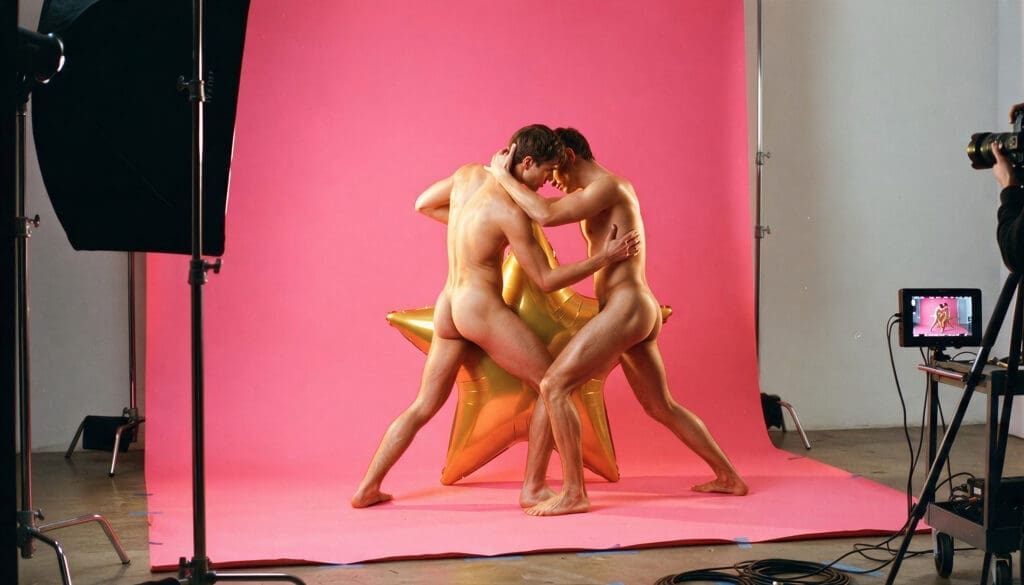
Through the 1990s and 2000s, David LaChapelle became one of the most in-demand celebrity and fashion photographers alive, shooting covers and campaigns featuring Britney Spears, Muhammad Ali, Lil Kim, and dozens of other major figures, always in elaborately constructed sets that owed as much to theater and film production as to still photography. Critics started calling him “the Fellini of photography” for the sheer scale and theatricality of what he built for a single frame. Even inside strictly commercial work, muscular male bodies appear constantly as spectacle in their own right — shirtless, oiled, staged with the same unembarrassed attention he gave his female subjects, never treated as a supporting element to someone else’s glamour.
A Photographer Who Never Hid His Gaze
The Male Body as Its Own Subject
LaChapelle’s fine-art work, especially after 2006, leaned even further into explicit homoerotic imagery — his Deluge series and the tableaux later grouped under American Jesus repeatedly cast heavily muscled, often nude or near-nude men inside apocalyptic and religious scenes, desire and devotion photographed as the same impulse rather than opposites. Where Mapplethorpe kept his explicit work separate from his commercial career, LaChapelle folded male eroticism directly into work commissioned for mainstream magazines, gambling that spectacle could carry content editors might otherwise have rejected outright.
Walking Away From Commercial Work
In 2006, at the height of his commercial career, LaChapelle largely stepped back from fashion and celebrity photography to focus on fine art and personal projects, including RIZE (2005), a documentary about the LA krumping and clowning dance scenes that carried the same physical intensity into a completely different, non-staged register. He moved to a farm in Hawaii for several years afterward, a deliberate distance from the industry that had made him famous, before returning gradually to gallery and museum exhibitions where the homoerotic register in his work only became more overt, not less.
Where the Spectacle Continues
NUBRONZE doesn’t share LaChapelle’s pop-art palette, but it shares something more structural: the conviction that a single image can be an entire constructed world rather than a captured moment, built rather than found, and that male desire deserves the same theatrical seriousness other subjects get by default. Auction of Prime Males runs on exactly that theatrical excess — men presented, staged, and displayed with a spectacle-driven intensity that has more in common with LaChapelle’s maximalist sets than with a straightforward documentary approach. Epics Uncut works the same instinct through a different vocabulary — an entire mythic world constructed around a single body, the same all-in production values LaChapelle applied to a magazine spread. The Favourite shares the method in a quieter register: every single diptych its own fully built world, a complete production for a single pairing. David LaChapelle sits inside a longer history NUBRONZE traces on The Lineage — discovered as a teenager by Andy Warhol, and working decades later in a wildly different register from Herb Ritts, another American photographer who spent his career in the same celebrity world. That history runs back further still, to the centuries before photography even existed as an option.
Did David LaChapelle openly photograph male eroticism?
Yes, especially after 2006 — his fine-art tableaux, including the Deluge and American Jesus series, repeatedly cast nude or near-nude muscular men at the center of the frame.
Was David LaChapelle open about being gay during his commercial career?
Yes — he was openly gay from early on, at a time when that carried real professional risk, and it shaped how directly desire showed up even in mainstream commercial work.
Why is David LaChapelle sometimes called "the Fellini of photography"?
Because of the sheer theatrical scale of his sets — each image built like a full film production rather than simply photographed.
Did David LaChapelle stop working in fashion photography?
Largely, yes — he stepped back from commercial fashion and celebrity work in 2006 to focus on fine art and personal projects.
Where can I see photography that carries a similar theatrical, maximalist instinct today?
Auction of Prime Males and Epics Uncut both build entire staged worlds around their subjects.