
Pier Paolo Pasolini: The Poet Who Filmed Bodies the Establishment Wouldn't
A Writer Before He Was a Filmmaker
Poetry, Scandal, and an Early Exile
Pier Paolo Pasolini built his reputation first as a poet and novelist in postwar Italy, writing in Friulian dialect and later in the slang of Rome’s poorest neighborhoods, work that got him expelled from the Italian Communist Party in 1949 after a morals charge tied to his homosexuality became public. He moved to Rome that same year, effectively starting over, and didn’t direct his first film until 1961 — by which point he already had a substantial literary career most filmmakers never come close to matching. He arrived in Rome with almost nothing, teaching in a school on the city’s outskirts while he wrote, years before film became any part of his plans at all.
From Neorealism to Provocation
His early films, Accattone (1961) and Mamma Roma (1962), stayed close to Italian neorealism — poor, working-class Rome, non-professional actors cast off the street rather than out of an agency. Over the following decade he moved toward increasingly mythic and provocative territory: Teorema (1968), The Decameron (1971), The Canterbury Tales (1972), and Arabian Nights (1974), collectively known as the Trilogy of Life, all built around raw physicality, explicit sexuality, and bodies that never looked like they belonged to a studio system. Each film in the trilogy adapted older narrative traditions — Boccaccio, Chaucer, medieval Middle Eastern tale collections — but filmed them with the same unpolished, physically direct camera he’d used on the streets of Rome a decade earlier.
A Body of Work That Refused to Soften Anything
Non-Professional Actors as a Principle
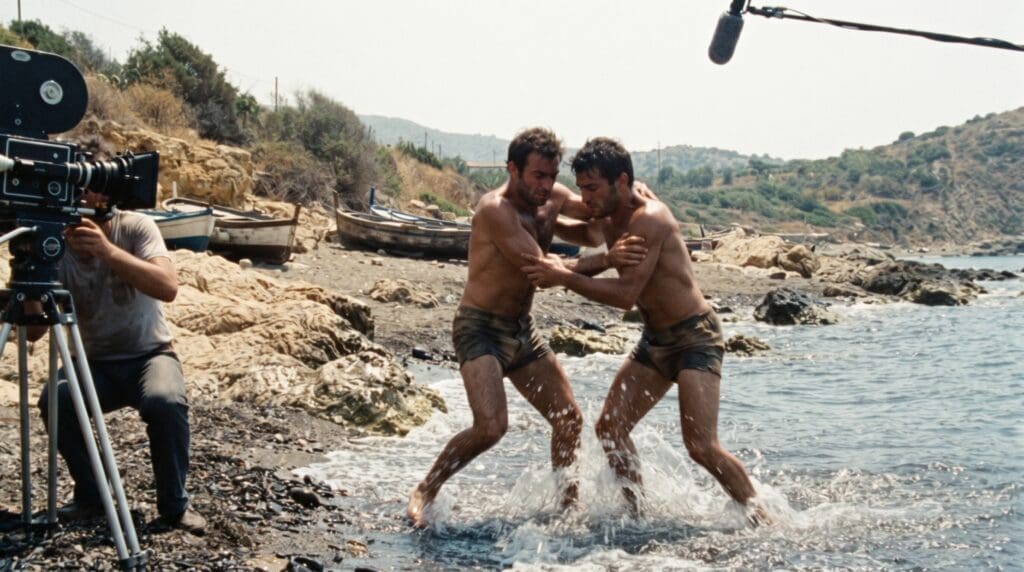
Pier Paolo Pasolini cast almost exclusively non-professional actors throughout his career — laborers, farmers, and young men recruited directly from the neighborhoods his films depicted, not because professional actors weren’t available to him, but because he believed something about real physical presence couldn’t be replicated by trained performance. His camera stayed close to skin, sweat, and the specific way an unglamorous body actually moves, a documentary instinct running underneath even his most mythological material. He often scouted for months before a shoot, choosing faces and bodies he found in the streets rather than working from a casting agency’s book.
Salò and a Death That Was Never Fully Explained
His final film, Salò, or the 120 Days of Sodom (1975), transposed the Marquis de Sade into fascist Italy and remains one of the most disturbing films ever released commercially, still banned or restricted in several countries decades later. Weeks before the film premiered, Pasolini was found beaten to death on a beach near Ostia. A young man was convicted of the killing and later claimed, decades afterward, that others had been involved — a claim that’s never been fully resolved, and that keeps Pasolini’s death itself a subject of ongoing dispute in Italy. He was fifty-three, and had spent his final years increasingly outspoken about Italian politics, corruption, and consumer culture in ways that made him no shortage of enemies.
Where the Raw Physicality Still Runs
Pier Paolo Pasolini’s insistence on real, unglamorous bodies over trained performance runs directly through The Spartan Bred — Niko Kallias cast his warriors from non-professional athletes specifically, the same conviction that authentic physical presence can’t be faked by someone simply performing it. The working-class physicality he filmed with such unflinching attention resurfaces too in MMA Sparring Partners, bodies built through actual labor and discipline rather than posed to resemble it. Rio Bare Plumes carries a quieter version of the same instinct — Caspian Ognok photographed many of his subjects in their own modest, often genuinely poor homes, a documentary honesty that sits in deliberate contrast with Carnival’s spectacle happening just outside, not unlike the tension Pasolini kept returning to between raw working-class life and the mythic register he sometimes wrapped around it. Pier Paolo Pasolini’s own place in that story runs through NUBRONZE’s wider Lineage, alongside Luca Guadagnino, another Italian filmmaker working the same Mediterranean landscape half a century later, in a far gentler key. Jean Genet sits behind both of them, part of the same story that runs back to the centuries before photography even existed.
Did Pasolini only make films about explicit sexuality?
No — he was primarily a poet and novelist before becoming a filmmaker, and Pier Paolo Pasolini's early films were closer to social realism than to explicit content.
Why did Salò shock audiences so much, and why does it still?
Because it refuses any comfortable distance — extreme violence and degradation get filmed with the same cold, clinical detachment Pasolini brought to everything, wrapped in a serious political allegory about fascism that denies viewers any easy way to dismiss it as either pure exploitation or safely abstract metaphor.
Why did Pasolini use non-professional actors?
He believed real physical presence and unglamorous bodies carried something trained performance couldn't replicate, and cast almost exclusively from the working-class neighborhoods his films depicted.
Was Pasolini open about being gay?
Yes, unusually so for his era — his sexuality was public knowledge for most of his career, tied directly to the 1949 morals charge that ended his Communist Party membership, and the raw, working-class male physicality that recurs across his films reflects the same interests that shaped his private life.
Where can I see photography that carries on a similar commitment to real, unglamorous bodies today?
The Spartan Bred is built around exactly that same conviction — authentic physicality over trained performance.