
Jean Genet: The Convict Whose Prose Built an Entire Cinema of Desire
From Reform School to the Petition That Saved Him
An Orphan Who Became a Career Criminal
Jean Genet was abandoned by his mother as an infant, raised by the French social welfare system, and sent to a reformatory by his teens for theft. What followed was two decades moving between prison sentences and vagrancy across Europe — stealing, some sex work, always writing, even inside prison cells with no expectation any of it would ever be published. By the late 1940s, French law’s habitual-offender statute meant Genet faced automatic life imprisonment for his next conviction. He had, by then, become the single most electrifying new voice in French letters, and the people who knew it went to work saving him. He wrote his first novel, Notre-Dame-des-Fleurs, on prison paper meant for rolling cigarettes, with no publisher in mind and no reason to expect one.
The Petition, and What It Actually Saved
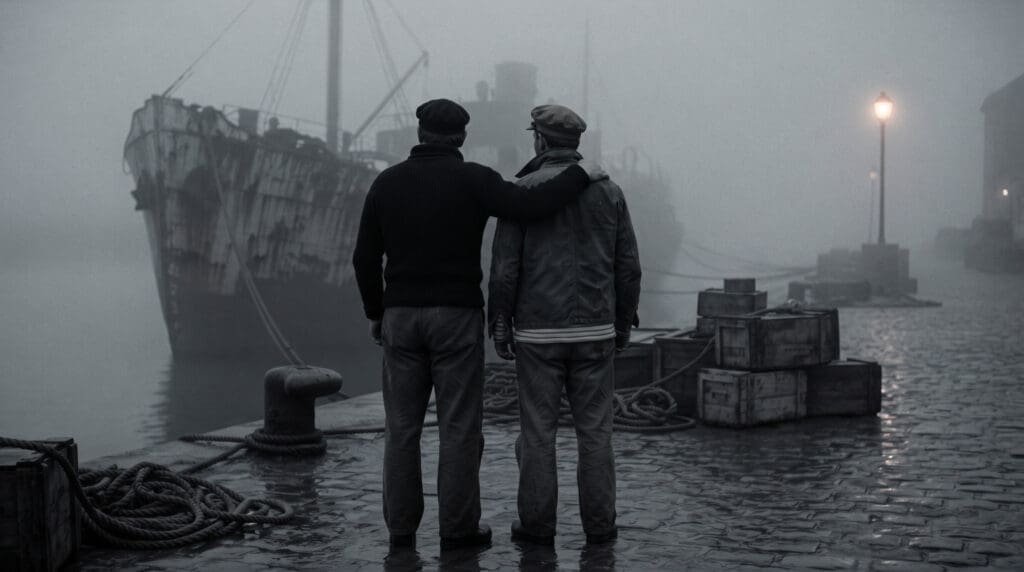
Jean-Paul Sartre, Jean Cocteau, and a roster of the era’s major literary figures petitioned the French president directly, and in 1949 Genet received a formal pardon. Sartre went on to write an entire 700-page philosophical study of him, Saint Genet, treating his life as a kind of inverted sainthood — abjection, criminality, and betrayal deliberately embraced rather than redeemed. The novels that made his reputation ran on exactly that inversion: Notre-Dame-des-Fleurs (1943), written in prison, and Querelle de Brest (1947), a murderer-sailor moving through a world where crime and male desire share the same vocabulary, betrayal itself treated as a species of intimacy. Genet never asked for that redemption himself. He kept writing about thieves and sailors and betrayal as though none of it needed apologizing for, which is precisely what unsettled and fascinated the intellectuals who saved him.
A Single Film, and an Influence That Outlasted It
Un Chant d’Amour
Genet directed exactly one film in his life: Un Chant d’Amour (1950), a silent twenty-six-minute short following two prisoners in adjoining cells who can’t touch each other, communicating desire through a hole in the wall between them, smoke passed mouth to mouth in the film’s most enduring image. It was banned outright in multiple countries for decades — the United States kept it out of legal circulation until a 1960s court case — and stands today as one of the earliest films to treat male desire between men as its entire subject rather than a subplot requiring justification. Jean Genet never made another film. He didn’t need to — this one carried enough charge to outlast every ban placed on it.
What Genet Handed to the Directors Who Came After
His influence on cinema runs directly rather than by inference. Rainer Werner Fassbinder adapted Querelle itself into his final film before his death in 1982, keeping Genet’s fusion of crime and desire almost entirely intact. Derek Jarman cited Genet as a direct, foundational influence on his own work, carrying the same refusal to treat transgression and eroticism as opposites into an entirely new generation of queer filmmaking.
Where That Refusal Still Runs
Genet never separated desire from danger, power, or betrayal — he built his entire body of work on the conviction that they were never actually separate to begin with. That same refusal to soften the connection between power and desire runs through NUBRONZE’s own Auction of Prime Males, where submission is contracted rather than romanticized and neither side pretends otherwise. His literary and cinematic influence runs more directly still through NUBRONZE’s own Lineage — Andy Warhol, Pier Paolo Pasolini, Andrew Haigh, and Luca Guadagnino all work, in different registers and different decades, inside territory Jean Genet opened first: male desire treated as worth a camera’s full, unapologetic attention.
Was Jean Genet actually a criminal, or is that exaggerated?
It’s accurate — he spent significant portions of his early adulthood in and out of French prisons for theft, and faced automatic life imprisonment under habitual-offender law before a 1949 presidential pardon, secured by a petition from Sartre, Cocteau, and other major literary figures.
What is Un Chant d’Amour about?
Two prisoners in adjoining cells, unable to touch, communicating desire through a hole in the wall between them — one of the earliest films to treat male desire as its entire subject rather than a subplot.
Was Un Chant d’Amour banned?
Yes, in multiple countries for decades. It stayed out of legal circulation in the United States until a court case in the 1960s.
Did Genet’s novels get adapted into film?
Yes — most directly, Rainer Werner Fassbinder adapted Jean Genet's Querelle de Brest as Querelle, his final film before his death in 1982.
Where can I see filmmakers Genet directly influenced?
Andy Warhol, Pier Paolo Pasolini, Andrew Haigh, and Luca Guadagnino all continue different threads of the territory Jean Genet opened first.