
Andrew Haigh: The Director Who Made Quiet the Point
A Career Built on Restraint
Editing Before Directing
Andrew Haigh worked for years as a film editor — including on studio productions like Gladiator — before directing his own features, a background that shows up constantly in how tightly controlled his own films are, nothing left in a scene that isn’t doing real work. His breakthrough came in 2011 with Weekend, a low-budget film about two men who meet on a Friday night and spend the following two days together before one of them leaves the country, made for a fraction of what most festival films cost. That editing background is worth dwelling on — few directors working today spent as long as Haigh did on the other side of the cutting room, learning exactly how much a scene can lose before it stops working.
From Weekend to a Wider Body of Work
Weekend established the register Haigh has largely worked in ever since: small casts, minimal plot, enormous attention paid to ordinary domestic detail. 45 Years (2015) and Lean on Pete (2017) extended that same patience to different subjects entirely — a long marriage, a teenage boy and a racehorse — before Haigh returned to explicitly gay material with the HBO series Looking (2014–2016), starring Jonathan Groff, Frankie J. Alvarez, and Murray Bartlett, and the feature All of Us Strangers (2023), starring Andrew Scott and Paul Mescal. Each film moves at roughly the same unhurried pace regardless of subject, a directorial signature as recognizable as any more visually flamboyant filmmaker’s.
Intimacy Without Spectacle
What Weekend Actually Changed
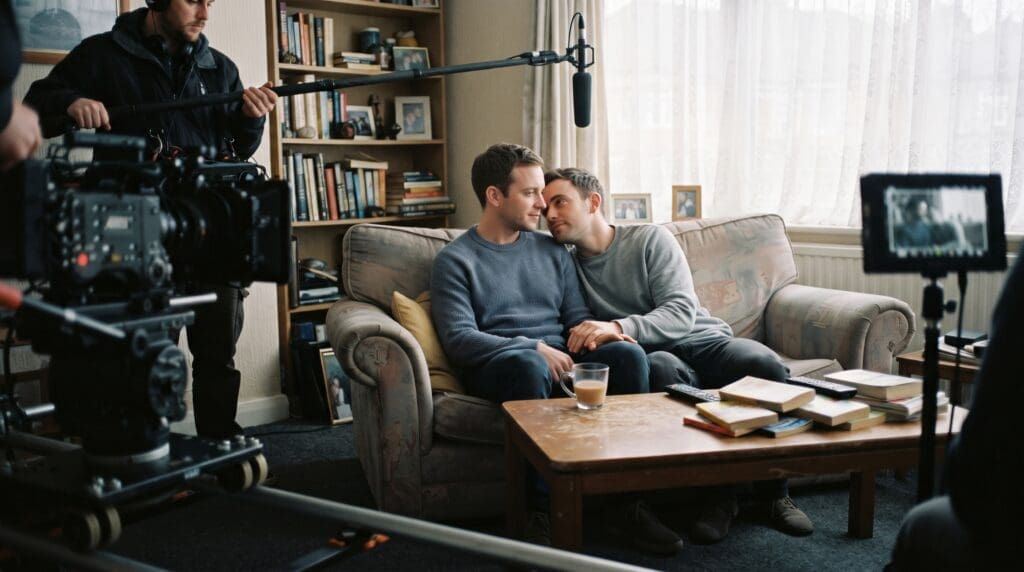
Weekend is widely credited as a genuine turning point in queer cinema specifically because of what it refused to do — no tragedy, no coming-out arc, no external conflict manufactured to justify the relationship existing on screen. The sex between Russell and Glen is filmed with the same unhurried naturalism as everything else in the film — handheld, mostly quiet, no score pushing the moment toward melodrama, bodies photographed in ordinary domestic light rather than anything stylized. Haigh lingers on the conversation before and after just as much as the act itself, drugs and morning-after awkwardness and the specific, unglamorous logistics of two near-strangers actually wanting each other, refusing to cut away the way most films still do once desire becomes explicit. The intimacy reads as real specifically because nothing about it is staged to look dramatic. Critics at the time noted how unusual it felt to watch a gay relationship on screen that wasn’t organized around external hostility or tragedy — the drama, such as it was, came entirely from inside the two men themselves.
Small Gestures, Full Weight
Across his entire filmography, Haigh’s camera consistently privileges the small physical gesture over the large emotional statement — a hand resting somewhere, a glance held a beat too long, silence allowed to sit rather than filled with dialogue explaining what’s happening. That restraint is a directorial choice as deliberate as any of Pasolini’s provocations or LaChapelle’s excess, just working in the opposite direction entirely. Actors who’ve worked with him describe him directing almost entirely through small adjustments — less, quieter, hold the moment longer — rather than through big conceptual notes about character or motivation.
Where That Same Patience Runs
Haigh’s conviction that a small gesture can carry more weight than a dramatic one runs directly through Taking the Photographer — the relationship between Caspian and Javier escalates through exactly the kind of unhurried, unstaged attention Haigh built his entire career on, nothing manufactured to force the tension along faster than it actually wants to move. MMA Sparring Partners carries a version of that same instinct in a very different setting — two men in a closed room, face to face, moving without any external conflict from confrontation into lovemaking, the same unforced escalation Weekend built an entire film around. The gentler side of that same patience shows up too in Wild Male Encounters, a companionable stillness built from the same small, unhurried attention. Andrew Haigh’s own place in that story runs through NUBRONZE’s wider Lineage, alongside the other filmmakers and photographers traced there. Jean Genet stands at the root of that same story, and it runs back further still to the centuries before photography even existed.
Is Andrew Haigh open about being gay, and how does he discuss it publicly?
Yes — he's spoken openly about his own sexuality in interviews for years, generally describing it as simply part of who he is rather than a defining public statement, an approach that matches the understated way his films themselves handle gay identity.
Why is Weekend considered important in queer cinema?
Because it depicted a gay relationship, sex included, without a tragic arc or external conflict manufactured to justify it — just two men, filmed with the unhurried naturalism Andrew Haigh became known for.
What is Looking?
An HBO series (2014–2016) Andrew Haigh created about gay life in San Francisco, starring Jonathan Groff, Frankie J. Alvarez, and Murray Bartlett, extending the same intimate, low-key register from his films into television.
What is All of Us Strangers?
A 2023 feature film by Andrew Haigh, starring Andrew Scott and Paul Mescal, returning to explicitly gay material after several projects in other registers.
Where can I see photography built on a similar patience today?
Taking the Photographer traces a relationship that builds with the same unhurried attention Andrew Haigh's films are known for.