
Luca Guadagnino: The Director Who Makes Desire Take Its Time
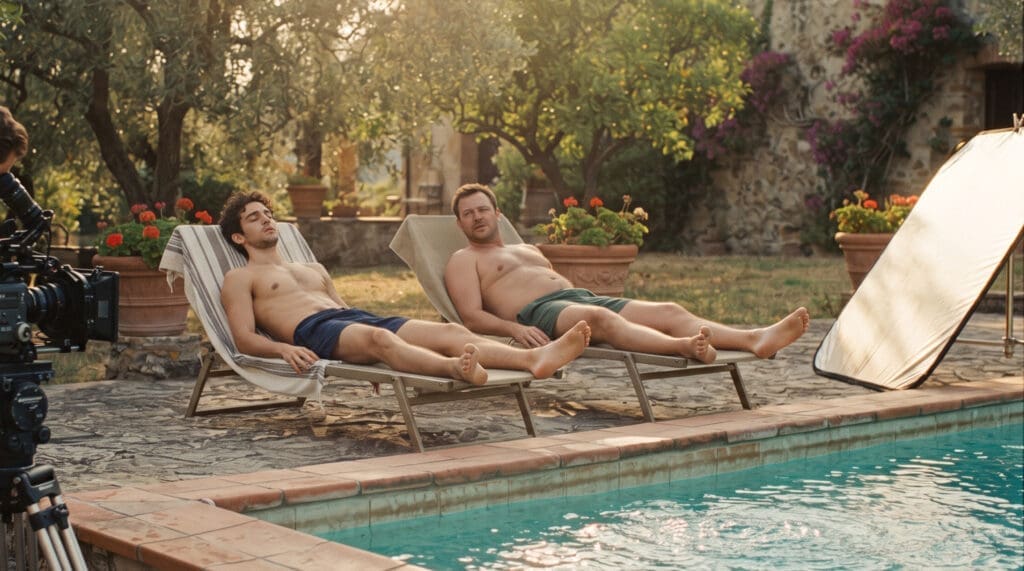
An Italian Filmmaker Who Took the Long Way
Early Work Before the Breakthrough
Luca Guadagnino directed documentaries and smaller features throughout the 1990s and 2000s — including a documentary on Bernardo Bertolucci and a fashion-world feature, Melissa P. (2005) — well before the film that made him internationally known. I Am Love (2009), starring Tilda Swinton, established the sensuous, slow-building style that would define the rest of his career: wealthy Italian settings, restrained surfaces concealing real desire underneath, sound and food and light all doing as much narrative work as dialogue. Guadagnino spent close to two decades working before that breakthrough arrived, a longer apprenticeship than most directors his level of fame eventually go through.
The Desire Trilogy and Beyond
I Am Love, A Bigger Splash (2015), and Call Me by Your Name (2017) are often grouped together as an informal “Desire” trilogy, united less by plot than by register — heat, water, fruit, skin, tension that builds through atmosphere rather than incident. Call Me by Your Name, adapted from André Aciman’s novel, became a genuine cultural phenomenon, and Guadagnino followed it with a much darker turn in Suspiria (2018) and Bones and All (2022) — the latter a road movie about young cannibals crossing the Reagan-era rural Midwest, Ohio and Kentucky and Missouri rendered as flatly and unglamorously as the horror at its center — before returning to a more overtly physical register with the tennis drama Challengers (2024).
Tension as the Actual Subject
The Slow Burn as a Directorial Signature
What distinguishes Luca Guadagnino from most directors working in similarly sensuous territory is patience — his films consistently delay a relationship’s actual arrival for as long as the story can bear it, building tension through glances, proximity, and unremarked physical closeness rather than through dialogue that announces what’s happening. By the time two characters actually touch in a Guadagnino film, the audience has usually been waiting for it far longer than the runtime alone would suggest.
How the Camera Actually Treats the Male Body
Guadagnino and his regular cinematographer Sayombhu Mukdeeprom shoot male nudity as continuous with landscape rather than singled out for emphasis — skin lit the same way sunlight falls on water or fruit, bodies allowed to simply exist in a frame rather than posed for it. The effect is deliberately more sensual than explicit: a bare shoulder catching afternoon light does more work in his films than a fully staged scene usually manages elsewhere. He’s been direct about where that instinct comes from — asked about his recurring subject matter in 2025, he said plainly, “I think every great movie is gay,” treating queerness less as a plot element than as a way of seeing that runs underneath the work itself.
Where That Same Patience Runs
Guadagnino’s insistence that desire needs room to build rather than being announced runs directly through Taking the Photographer — the escalation between Caspian and Javier follows exactly that same unhurried arc, tension accumulating through proximity and small shifts in attention long before anything resembling a plot point actually happens. The Spartan Bred carries a related idea from the opposite direction: constant physical contact between men, sustained long enough, becomes its own kind of inevitability, bodies arriving at union less through decision than through sheer accumulated proximity. The sun-drenched, water-adjacent sensuality that defines so much of Guadagnino’s visual language surfaces again in Rio Bare Plumes, where heat and light carry as much of the desire as anything more explicit does. Guadagnino’s own place in that story runs through NUBRONZE’s wider Lineage, alongside Pier Paolo Pasolini, the Italian filmmaker who worked the same Mediterranean landscape decades earlier, in a far harder register. Jean Genet sits behind both of them, part of the same story that runs back to the centuries before photography even existed.
Does Luca Guadagnino film nude men and lovemaking?
Yes, frequently — his films consistently treat male nudity and physical intimacy as central rather than incidental, shot with the same sensuous attention to light and skin across his whole filmography.
Did Luca Guadagnino really say "every great movie is gay"?
Yes, in 2025. He wasn't speaking literally about sexual content — he meant that the greatest films tend to come from a position off-center, oblique to the mainstream, and that queerness works as a useful stand-in for that kind of outsider vantage point regardless of what a film is actually about.
Has Luca Guadagnino directed outside romantic drama?
Yes — Suspiria (2018) is a horror remake, Bones and All (2022) a road-movie horror hybrid, and Challengers (2024) a tennis drama.
What makes Guadagnino's directorial style distinctive?
A consistent patience — tension in Luca Guadagnino's films builds through atmosphere, setting, and proximity rather than through dialogue that announces what's happening.
Where can I see photography built on a similarly slow-building tension today?
Taking the Photographer traces a relationship escalating with that same unhurried patience.