
Andy Warhol: The Pop Artist Who Never Stopped Photographing Desire
From Commercial Illustrator to Factory Icon
A Career Built on Repetition
Andy Warhol trained as a commercial illustrator in Pittsburgh before moving to New York in 1949, and spent the 1950s drawing shoes and advertisements before pivoting, almost overnight, into the silkscreened Campbell’s Soup cans and Marilyn Monroe portraits that made him famous by the early 1960s. The technique itself — mechanical repetition, flat color, the removal of the artist’s hand from the final image — became the argument as much as any single picture did: that mass production and fine art didn’t have to stay in separate rooms. He was famously, deliberately opaque about his own inner life, giving interviews that answered almost nothing, letting the work itself do whatever explaining he was willing to offer.
The Factory and Its Cameras
Warhol’s studio, the Factory, became the center of a genuinely strange corner of 1960s New York — actors, musicians, addicts, and socialites orbiting a man who rarely spoke much and filmed almost everything. He shot hundreds of hours of static, unedited footage during this period: Sleep (1964), five hours of a man sleeping; Empire (1964), eight hours of the Empire State Building at night; and, less discussed but just as deliberate, films like Blow Job (1964) and My Hustler (1965), which pointed his fixed, unblinking camera at male sexuality with the same flat, observational patience he gave a soup can. That same fixation carried into three feature-length films Warhol produced and Paul Morrissey directed — Flesh (1968), Trash (1970), and Heat (1972) — all starring Joe Dallesandro as a hustler drifting through New York’s underground, explicit and unglamorous in ways mainstream cinema wouldn’t attempt for decades. Dallesandro’s constant nudity across the trilogy made him one of the era’s defining queer icons, even though he identified as straight throughout.
A Body of Work Split Into Two Registers
Public Pop, Private Polaroids
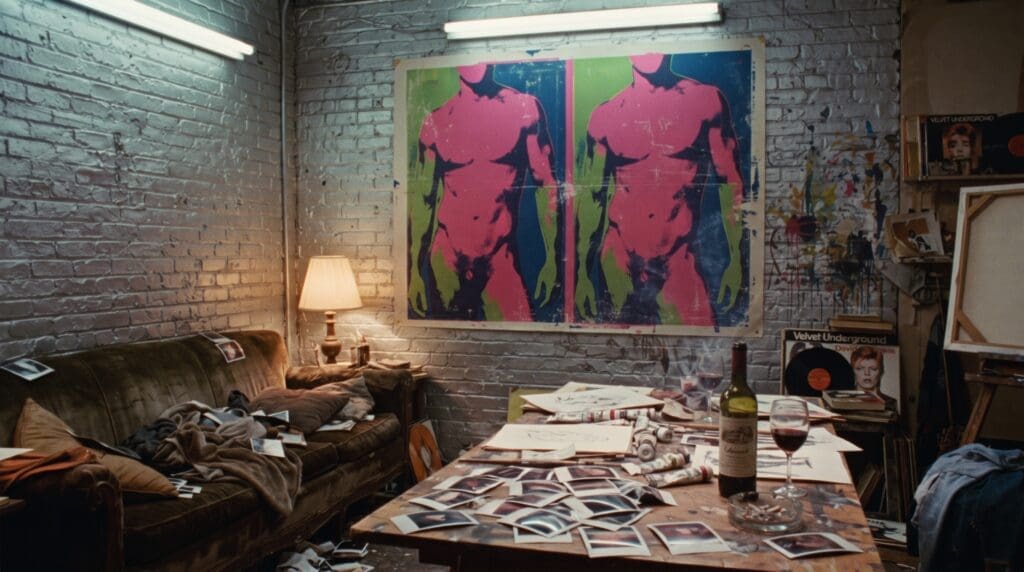
Alongside the soup cans and celebrity silkscreens that made him a household name, Andy Warhol shot an enormous private archive of Polaroid photographs throughout the 1970s and into the 80s, a large portion of them explicit male nudes — later collected and published posthumously as Sex Parts and Torsos. The two bodies of work rarely got shown together during his lifetime, but they share the same underlying instinct: cataloguing, repeating, treating a body or an object as a specimen to be recorded rather than a moment to be captured once. He shot these Polaroids compulsively, often of assistants, boyfriends, or visitors passing through the studio, treating the camera almost like a diary entry rather than a finished work meant for anyone else to see.
Survival and a Changed Practice
In 1968, Warhol was shot and nearly killed by Valerie Solanas, a writer with a tenuous connection to the Factory scene, and spent the rest of his life in significant physical pain from the injury. His work afterward grew more commercial and more guarded, though the private Polaroid archive continued largely unchanged, almost the one place his practice never really shifted. He died in 1987 from complications following gallbladder surgery, at 58. Friends who knew him in both periods often describe the shooting as a real dividing line — the public persona grew warier, even as the private camera kept working exactly as it always had.
Where the Cataloguing Instinct Continues
Warhol’s instinct — that a body, photographed repeatedly and systematically, becomes something closer to a specimen than a portrait — shows up in a very different register throughout NUBRONZE’s own catalogue. Auction of Prime Males runs on exactly that logic: men catalogued according to a fixed template, repeated across dozens of entries, the same cold systematic recording Warhol applied to his own Polaroid archive decades earlier. His fixed, unblinking camera — pointed at real bodies doing what they actually do, never staged, never directed toward a performance — resurfaces in a quieter register throughout The Spartan Bred, which holds the same observational patience, waiting rather than orchestrating. MMA Sparring Partners works the same instinct in a documentary key, watching real physical contact unfold rather than staging it. Neither series shares his silkscreen aesthetic, but all three share the deeper instinct behind it: that repetition and patience themselves can be a way of actually looking. Andy Warhol’s own place in that story runs through NUBRONZE’s wider Lineage — the Factory scene Robert Mapplethorpe circled as a young photographer, and the magazine where he later gave David LaChapelle his first job. Jean Genet worked that same instinct in a different medium a decade earlier — part of the same story that runs back to the centuries before photography even existed.
Did Andy Warhol make explicit films?
Yes — films like Blow Job (1964) and My Hustler (1965) engaged directly with male sexuality, shot with the same static, observational style as his more famous experimental films.
What is Sex Parts?
A posthumously published collection of Andy Warhol's private Polaroid photographs, largely explicit male nudes, shot throughout the 1970s and 80s.
What is the Flesh, Trash, Heat trilogy?
Three feature films Andy Warhol produced and Paul Morrissey directed, starring Joe Dallesandro as a hustler moving through New York's underground — explicit, unglamorous, and enormously influential in queer cinema history.
Was Andy Warhol only a photographer?
No — he worked simultaneously as a painter, filmmaker, producer, and cinematographer, treating all of it as one continuous project rather than separate careers.
Where can I see photography that carries on a similar cataloguing instinct today?
Auction of Prime Males runs on a closely related systematic, repeated approach to documenting men.