
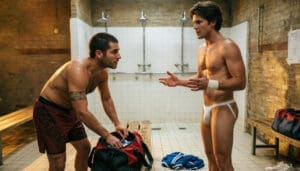
Sport didn’t discover nudity recently. The ancient Greek gymnasion — literally “place to be naked” — trained and competed men nude as a matter of course, no shame attached, the body simply present the way it is on a field today. Before Photography traces that history in full, and Epics Uncut picks the same premise back up on screen. What’s strange is what happened after clothing came back: instead of covering more, modern athletic wear has spent a century moving the other direction. The singlet clings rather than conceals. A swim brief, a compression top, a wrestling singlet — each one reveals more precisely because it was never designed to hide anything in the first place, just to move. Gay athletes as a fantasy runs on exactly that gap: uniforms built for performance that happen to expose everything performance requires. The jockstrap sits apart from all of it — arguably the most charged piece of athletic underwear in the American sports imagination anyway, precisely because it isn’t seen: a suggestive pouch and bare ass built into the garment itself, worn under the uniform rather than as it, which is exactly what’s made it a major fixture of the M2M fantasy around athletes specifically.
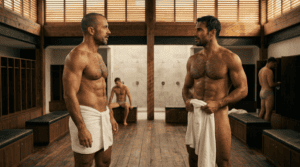 Not every sport exposes the body the same way, and the differences matter. Swimming puts a man nearly nude, skin wet, muscle visible under a suit built to disappear against the body rather than announce itself. Wrestling collapses all distance entirely — two men locked together, weight against weight, a kind of sustained contact no other sport sanctions this openly. Beach volleyball keeps the body in near-constant motion and near-constant view, chest and thighs exposed for the length of the match rather than glimpsed once. Rugby and American football add controlled violence to the mix — the tackle, the scrum, bodies colliding on purpose, aggression that reads as intimacy the instant the whistle stops. And what happens after the whistle carries its own charge: a handshake held a beat too long, a chest bump, a pile of bodies celebrating a win, teammates who’ve spent the whole match touching each other now doing it without any rule requiring it anymore. Gay athletes, as a search and as a fantasy, moves through all of it — the exposure built into the uniform, the contact built into the rules, and the affection that surfaces once competition ends.

The desire NUBRONZE finds in gay athletes isn’t added after the fact — it’s already running underneath the effort itself. A man doesn’t have to stop competing to start wanting his opponent; the same physical intensity that wins a match is the intensity that turns into something else the second the outcome stops mattering. That fluidity — desire moving as freely as the bodies producing it, admiration for another man’s physical effort curdling into something more specific without either man needing to announce the shift — is the real engine behind every gay athletes fantasy NUBRONZE publishes. Heated Rivalries works this territory across twenty-eight different sports, competitive bodies photographed at the exact moment rivalry turns into wanting — and turns explicit between rivals rather than stopping short of it. MMA Sparring Partners documents that same fluidity from the inside: two fighters who make love in direct continuation of what their training together already built between them. The Spartan Bred draws the same fantasy back to an older register entirely — the line connecting sport, physical effort, and war, one more universe where the same desire runs underneath. Between the three, and Epics Uncut besides, the fantasy gets covered from every direction the ancient world and the modern locker room both offer.