

An Old Fact, Not a New One
The connection isn’t a modern invention. Greek wrestling — pale — was practiced nude, in oiled skin, in a dedicated space, the palaestra, built for exactly this. The nudity wasn’t incidental to the sport; it was the point, a display of the male body as much as a contest of strength. The Spartan Bred draws directly on that history — Niko Kallias, a trained Greco-Roman wrestler himself, filmed his Spartan warriors nude from the first frame specifically because that’s how antiquity actually practiced the sport, not as a modern liberty taken with the past. The wrestling sequences in that film are, by design, closer to a historical record than an invention. Whatever gay wrestlers means to a contemporary search, its oldest version was never hiding anything to begin with.
The Singlet Solves a Problem Nudity Never Did
Which makes the singlet, centuries later, a strange kind of substitute — and arguably a more effective one. Full nudity, once it’s simply given, can flatten into fact; there’s nothing left to suggest. The singlet does something nudity can’t: it clings, it outlines, it leaves genitals visible in shape if not in detail, and it puts the question of what’s underneath permanently in play rather than settling it. A modern wrestling singlet is, in a real sense, more overtly erotic than the naked palaestra it descends from — a garment built for compression and mobility that happens to also be one of the most sexually legible pieces of clothing in athletics.
The Amorce That Cinema Got There First
Wrestling as a prelude to sex is such a fixture of gay pornography that it’s easy to forget the trope didn’t start there. One of the most famous wrestling scenes in cinema history is entirely mainstream: two men, nude, grappling by a fireplace in a British manor house, in a film from 1969 that critics still discuss for exactly this scene. The wrestling was never explained as anything other than wrestling, and it didn’t need to be — the charge was already built into the choreography, the duration, the way the camera refused to look away. Gay pornography didn’t invent the device. It recognized one that respectable cinema had already proven.
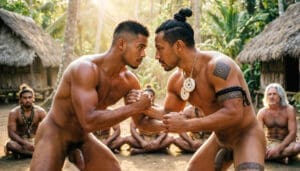
Wild Male Encounters plays the same device twice, deliberately, with the same two men. The first wrestling match in the film reads as pure conflict — real aggression, a genuine contest neither man is performing. The second, later, is something else entirely: the same physical contact restaged as ritual, an open celebration of strength and masculinity between men who’ve stopped competing and started admiring. Same grip, same bodies, opposite meaning. It’s a rare case of a film making the amorce explicit by showing both versions of it side by side.

The Grammar of Being Taken Down
Underneath the choreography, wrestling runs on a mechanic that translates almost too easily: one man overpowers another, pins him, holds him down until he stops resisting. That structure doesn’t need to be reinterpreted to read as sexual — it already has a top and a bottom built into its rules, a winner who controls and a loser who’s controlled. Heated Rivalries leans on exactly that overlap, at a scale where the metaphor stops being a metaphor: strip the kit away from a wrestling pin, and what’s left is barely distinguishable from the act it was always gesturing toward.