
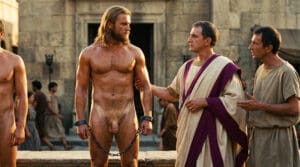
The 19th century picked the same gaze back up directly. Jean-Léon Gérôme’s Pollice Verso (1872), one of the most famous gladiator paintings ever made, shows a muscled victor with his foot on a defeated opponent’s throat — composed so the body carries as much weight as the gesture deciding a man’s fate. Hollywood inherited that same instinct. Kubrick’s Spartacus (1960) included a scene between Laurence Olivier and Tony Curtis — oysters and snails, discussed as a thin metaphor for bisexuality — considered explicit enough by the censors of the time that it was cut from prints for decades afterward.
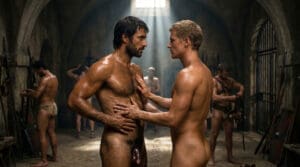
Starz’s Spartacus (2010–2013) did more than any production before it to turn the gladiator into an openly desired object — systematic full-frontal nudity, explicit sex scenes that included M2M content between several characters, a warrior’s frame shown without any of the old restraint. Pompeii (2014) took a more commercial path but stayed just as physical — Kit Harington, playing Milo, visibly transformed for the role, his physique becoming the film’s real selling point, embraced and eroticized by a gay audience well beyond anything the film’s own storyline (a conventional straight romance) actually offered. Between the two productions, gay gladiators moved from subtext to text without ever needing to announce the shift.
The warrior-slave tension is what actually drives gay gladiators as a fantasy — total physical power housed inside a form that legally belongs to someone else, ordered to fight, to die, to please. The physical reality explains most of it. A gladiator lives entirely through his build — it’s the only tool that keeps him alive, and he’s already spent years learning that his flesh exists to be used by someone else’s decision, not his own. That conditioning is exactly what makes the sexual version of being used read as continuous rather than forced: he doesn’t protest, because protesting was never part of the deal to begin with. Everything about him reads as dominant on the surface — muscled, mentally hardened, incapable of hesitation because hesitation gets a man killed in the arena. And underneath that surface sits the part of the fantasy that actually lasts: a gladiator’s history is almost always one of real damage — captured, enslaved, humiliated before he ever became formidable. The ultra-masculine exterior isn’t the whole story. It’s covering a man worth comforting as much as conquering.
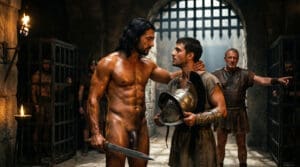
There’s a harder version of the same fantasy too, sitting right alongside the tender one rather than replacing it: being handed over to a gladiator specifically to satisfy him, no pretense of equality involved. He’s a killer by trade, trained to survive on instinct rather than restraint, and servicing that appetite carries real risk with it — the specific charge of danger, of someone strong enough to actually hurt you choosing not to, at least not more than you asked for. It’s BDSM in its purest form: the thrill isn’t despite the violence he’s capable of, it’s built directly on top of it. Epics Uncut works this exact register directly. The gladiator never really left, either — a boxer, a wrestler, or a mixed martial artist today carries the same premise forward almost unchanged: a body trained to hurt and be hurt, paid to perform violence in front of a crowd, admired for exactly the same combination of strength and risk Rome once put on public display. MMA Sparring Partners works that exact modern equivalent directly, two fighters whose training already runs on the same controlled violence the arena once demanded. Heated Rivalries carries the same mechanic into a wider range of sports, competitive men whose contact turns physical for reasons the game itself never quite explains. The gladiator’s private world — barracks, shared baths, a strict hierarchy among men locked in together — echoes other fantasy universes already running through NUBRONZE: prison, the locker room, the military barracks. The Spartan Bred shares the same terrain of forced brotherhood and bodies shown without apology, part of a wider Original Work catalogue built on the same instinct.