
Robert Mapplethorpe: The Formalist Who Photographed What Wasn’t Supposed to Be Beautiful
A Career Built on Two Halves
From the Factory’s Edge to His Own Studio
Robert Mapplethorpe arrived in New York in 1963 to study at the Pratt Institute, and spent his early twenties circling the edges of Andy Warhol’s Factory scene without ever quite belonging to it. His real formation happened somewhere else: in a relationship with Patti Smith, documented in her memoir Just Kids, and in a long partnership with curator and collector Sam Wagstaff, whose money and connections gave Mapplethorpe the resources to move from collage and Polaroids into large-format studio photography by the mid-1970s. By the end of that decade he had built a body of work split cleanly into two subjects that critics have spent decades trying to reconcile: flowers, shot with the same cold clarity as everything else he touched, and the male body, often Black, often nude, engaged in bondage, fisting, and S&M acts he photographed with the same clinical precision as everything else in his catalogue. He had almost no formal training in photography itself — his early background was in painting and sculpture at Pratt, which shows up constantly in how deliberately composed even his most explicit images are.
The X Portfolio and What Came After
His most confrontational work, the 1978 X Portfolio, documented New York’s underground BDSM and leather scene with total formal control — no grain, no snapshot aesthetic, just symmetry, hard studio lighting, and total technical mastery applied to subject matter that had never received it before. That collision defined the rest of his career. When a 1989 retrospective, The Perfect Moment, opened in Cincinnati months after his death from AIDS-related complications, the museum’s director was criminally charged with obscenity — and acquitted, in a trial that became one of the defining art-censorship cases of the era. The trial turned Mapplethorpe into a genuine flashpoint in the American culture wars of the early 1990s, cited constantly in Congressional debates over National Endowment for the Arts funding happening at almost the exact same moment.
A Formalism That Never Apologized
Sculptural, Not Confessional
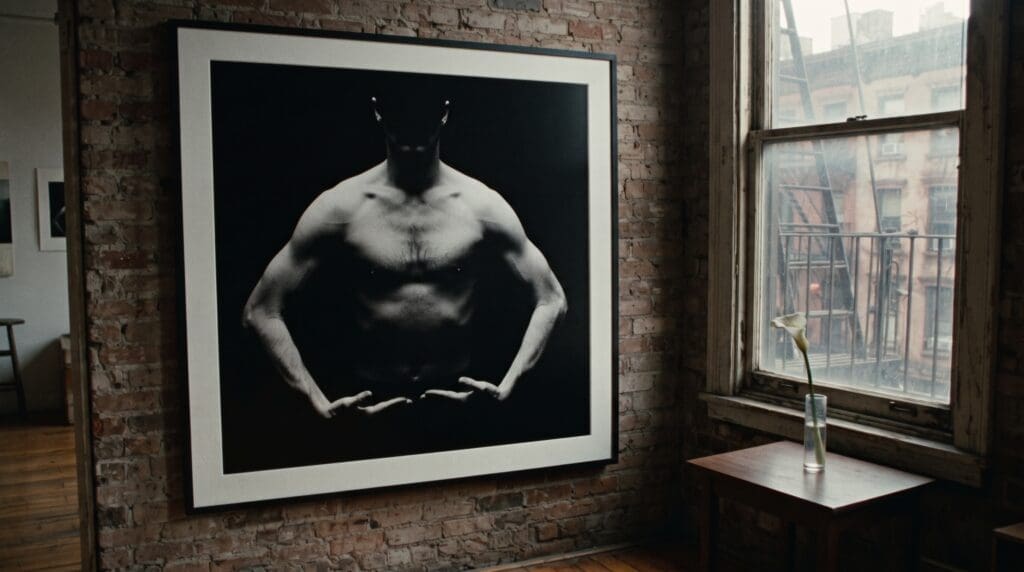
What separates Robert Mapplethorpe from most photographers working in similar territory is a near-total absence of vulnerability in the images themselves. His nudes read as sculpture — hard-edged, centered, lit like Greek marble rather than like a person caught in a private moment. He photographed the male body the way earlier photographers photographed flowers: as form first, subject second. That formal coldness is exactly what made the work so hard to dismiss as mere provocation. It looked too much like art history to be waved away as pornography, and too explicit to be fully absorbed into art history either. Even his most extreme images from the X Portfolio hold the same centered, deliberate symmetry as his celebrity portraits — the same discipline applied without exception, whatever the subject.
An Unfinished Argument
The work also carries a genuine, still-debated tension: several critics, including bell hooks, have argued that Mapplethorpe’s classical treatment of Black male bodies specifically repeated older patterns of objectification even while claiming pure formal intent. That critique hasn’t faded with time, and it’s worth sitting with rather than smoothing over — Mapplethorpe’s formal rigor doesn’t cancel out the question of who was being looked at, and by whom, even four decades later. It’s a genuine tension inside the work itself, not a footnote to dismiss on the way to admiring the craft.
Where That Argument Still Runs
NUBRONZE inherits more of Robert Mapplethorpe’s instinct than most of what currently gets made under the “erotic photography” label — the conviction that explicit content deserves the same formal seriousness as anything else a camera can point at, not a lesser register reserved for lesser images. Taking the Photographer runs on a closely related premise: a photographer, Caspian Ognok, whose entire practice is built on the relationship coming before the image, control and intimacy treated as the same discipline rather than opposites. The X Portfolio’s specific territory — power, restraint, submission staged with total formal control — surfaces again in Auction of Prime Males, where consent and control get photographed with the same clinical precision Mapplethorpe applied to leather and rope. And the raw physical crudeness he never softened for the camera runs through Heated Rivalries too, in a completely different register — competitive contact treated as bluntly as anything in the X Portfolio, just with a different sport supplying the choreography. It’s not a direct homage, in any of the three. It’s the same argument, continued, decades later and on the other side of a very different medium. Robert Mapplethorpe himself sits inside a much longer tradition NUBRONZE traces on The Lineage — including Andy Warhol, whose Factory scene Mapplethorpe circled as a young photographer before finding his own voice entirely apart from it. That tradition runs back further still, to the centuries before photography even existed as an option.
Was Robert Mapplethorpe’s work actually put on criminal trial?
Yes — in 1990, the Cincinnati Contemporary Arts Center and its director were charged with obscenity over the The Perfect Moment exhibition. Both were acquitted.
What is the X Portfolio?
A 1978 series by Robert Mapplethorpe documenting New York's underground BDSM and leather subculture, shot with the same formal precision he applied to his flower photography.
Did Robert Mapplethorpe photograph anything besides explicit content?
Extensively — flowers, celebrity portraits (including Patti Smith and later figures like Arnold Schwarzenegger), and classical studio nudes make up a large share of Robert Mapplethorpe's catalogue.
How did Robert Mapplethorpe die?
From complications of AIDS in 1989, at 42, shortly before his largest retrospective opened.
Where can I see photography that carries on a similar formal tradition today?
Taking the Photographer, NUBRONZE’s own series built around a photographer’s formal and relational discipline, sits closest to that lineage.