
Rio Bare Plumes
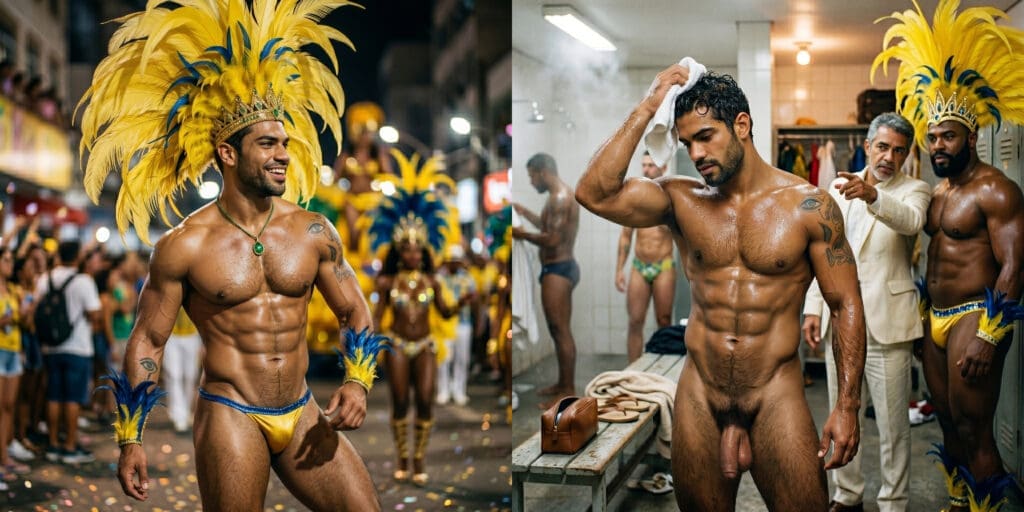
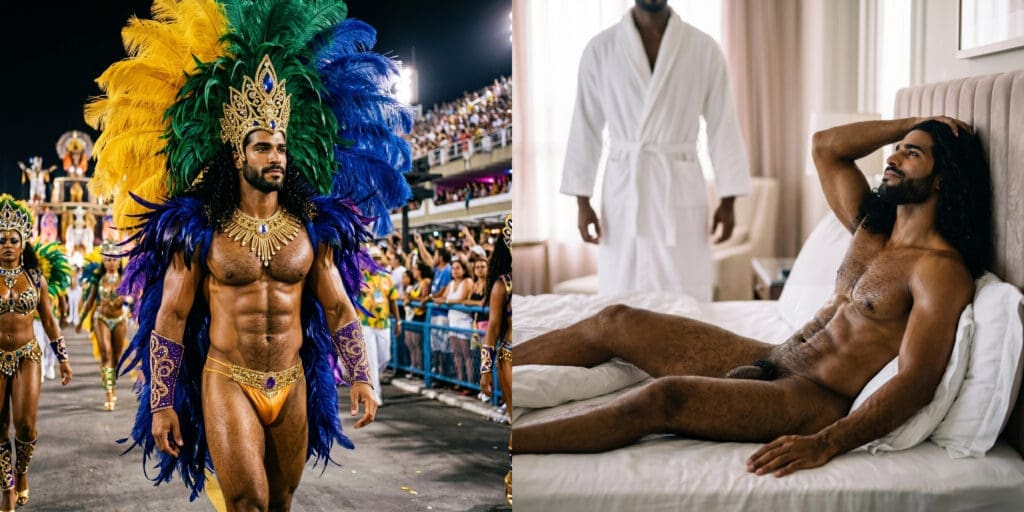
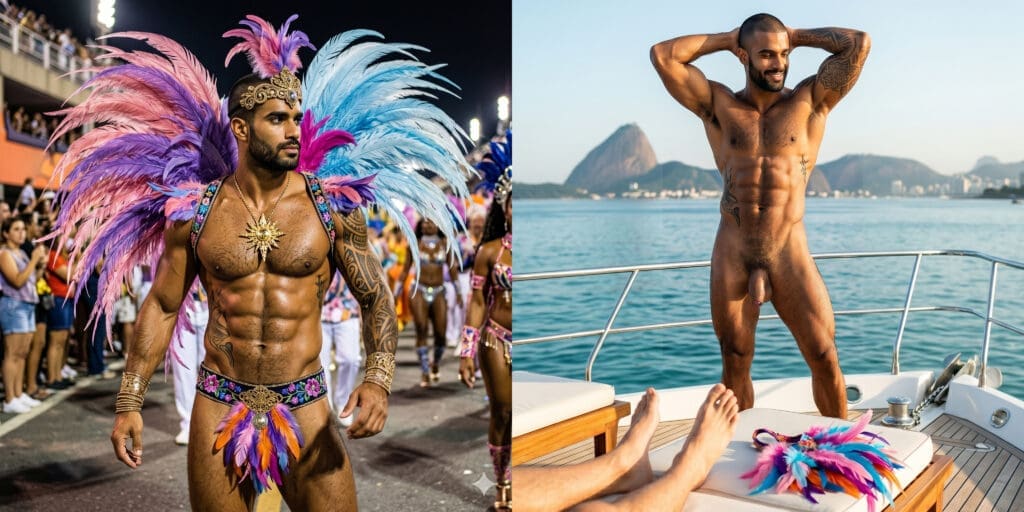
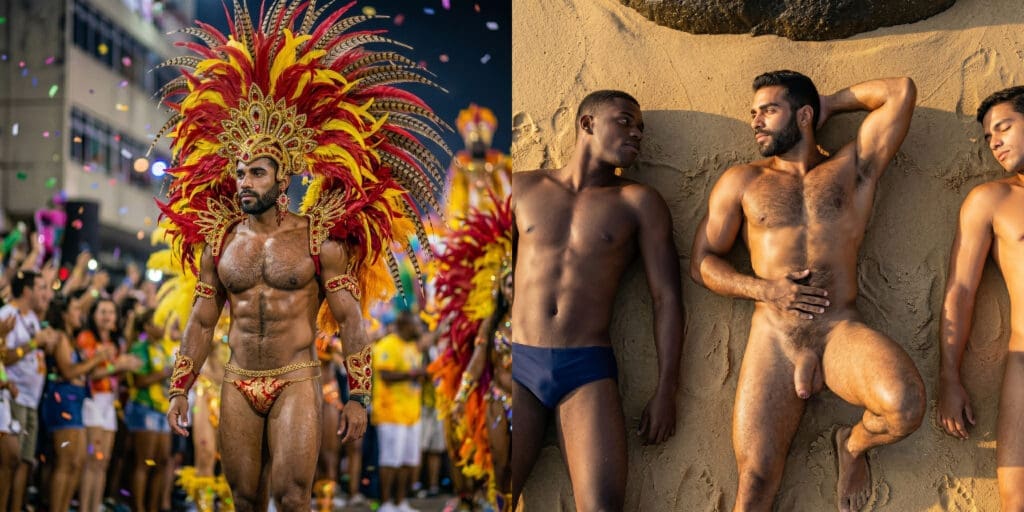
Forty diptychs, forty different men, one Rio de Janeiro carnival caught from both sides of the costume. Each pairs the same man twice — once in full parade feather and sequin, once stripped down to nothing but himself, somewhere the crowd never gets to follow him. Carnival gets photographed by everyone. Almost nobody photographs it this way. Caspian Ognok looked at the Sambódromo and saw a gap where gay carnival photography should have existed already — not a niche within the genre, but a genre nobody had quite built yet. Rio Bare Plumes is his answer to that absence: a single formal idea doing as much work as the image itself, repeated forty times without repeating itself once.
The Diptych Is the Argument
Two Frames, One Bet
A single striking photograph of a carnival dancer says one thing: this man is beautiful, on this stage, in this light. Rio Bare Plumes says something else by refusing to stop there. Every entry in the series pairs that public image with a second one — the same man, an hour or a night later, in a dressing room, a modest bedroom, a stranger’s penthouse, wherever the costume actually comes off. The contrast between the two frames does the work no single image could — the real engine behind this piece of gay carnival photography: parade against intimacy, spectacle against exposure, the plume against the body that was wearing it.
Caspian Ognok built the series on a simple bet — that carnival doesn’t create desire so much as sublimate it, take what’s already there in a body and push it toward something theatrical for one night. The diptych form exists to test that bet honestly. Photo A shows the sublimation. Photo B shows what it was standing on top of the entire time. Neither half is the point on its own; the gap between them is.
Built on Invention, Not Reportage
The premise underneath the whole series leans closer to invention than reportage. Rio Bare Plumes imagines a carnival running on a current of M2M desire that never stays fully contained to the stage — wealthy cariocas paying for nights with the dancers they’ve spent a week watching, dancers who are just as often the ones doing the pursuing, an entire city’s attention treated as something that doesn’t just flatter a performer but remakes him, for the length of carnival, into a man defined by how badly other men want him. The adulation of the crowd and the exaggerated sensuality the Sambódromo demands of every performer aren’t backdrop here — they’re the mechanism. Gay carnival photography, as NUBRONZE practices it, doesn’t document that world so much as build it, one diptych at a time.
Forty Men, Five Registers
No Lead Character, No Fixed Order
None of the forty men in Rio Bare Plumes recur, and no single diptych has to come before another — each one is its own complete unit, and the series works as a collection rather than a story told through one man. What the five registers below do trace, across the collection as a whole, is the arc of a carnival night itself: preparation before the avenue, the performance in it, and the comedown after — before, during, and after, just spread across forty different men rather than followed through one.
The Five Registers
Some entries catch a dancer in preparation — oiled skin, makeup half-finished, the stretch before he has to hold a pose for hours. Others land inside the performance itself, a stolen kiss in a technical corridor the cameras weren’t pointed at. A third register picks up the comedown: makeup coming off, communal showers, the particular exhaustion of a body that’s been on display all night. A fourth moves somewhere unexpected — penthouses, yachts, a private hammam, carnival’s less-photographed relationship with money and the men it attracts. And a fifth stays close to the ground: modest apartments, a deserted cove outside the city, a kiss on sand with no theater left in it at all.
What Every Diptych Signals
Every private-side image carries some signal of M2M desire, whether that’s a second man visible in the frame, a reflection, a partner’s hand, or a kiss outright — never staged the same way twice, but never absent either. This gay carnival photography isn’t shy about what the parade was always circling. The angle on the body varies deliberately too, series-wide — most diptychs hold the frontal view, some turn the man around entirely, a few catch him at three-quarters mid-motion, so no two entries read as a repeat of the last one.
One Recurring Light
Keeping forty different men visually coherent as one piece of gay carnival photography, without ever repeating a face, is its own kind of discipline — the same standard NUBRONZE holds across its male nude photography generally, applied here at a scale most series never attempt. What holds Rio Bare Plumes together isn’t a recurring character but a recurring type of light: the harsh, celebratory glare of the Sambódromo on one side of every diptych, something quieter and more particular to each man’s own life on the other. That shift in light does almost as much narrative work as the nudity itself — it’s the visual signal that the performance has actually ended.
Caspian Ognok’s Rio de Janeiro
A Photographer Who Lived There
Caspian lived in Brazil before he ever pointed a camera at a Sambódromo dancer, and it shows in what he chose to photograph. His years there were spent mostly among the men who actually carry Rio’s samba schools — not the headline performers, but the working-class dancers, drummers, and costume crews who rehearse year-round for one week of spectacle. Rio Bare Plumes is, in large part, a tribute to them: to the devotion it takes to give a body over to carnival that completely, to a beauty and an openness Caspian found nowhere else in quite the same measure, to a masculinity that never asked to be softened to be desirable. He didn’t arrive as an outsider looking in. He took more than one lover from that world over the years, and it’s that closeness — not distance, not tourism — that the series works from. Caspian has said as much himself: before he picked up a camera in Rio, gay carnival photography barely existed as its own genre — carnival got photographed constantly, but almost never through this particular lens. That absence is part of what drew him to it in the first place.
Why NUBRONZE Publishes It
This is why NUBRONZE places Caspian inside its embodied eroticism current specifically for this series, alongside his work on AOPM and Taking the Photographer. The desire in Rio Bare Plumes was never performed for the camera in either half of the diptych — it’s there in the parade because these men are genuinely magnetic on that stage, and it’s there in private because it never left. Caspian’s job was access and juxtaposition, not invention. What NUBRONZE responds to isn’t the nudity in isolation; it’s a piece of gay carnival photography that makes an actual claim — that the costume and the body underneath were never two different men, just two lights on the same one.
It’s also, structurally, one of the more forgiving series to pick up midway. With no recurring character and no required order between entries, there’s no correct place to start — a new viewer can open on diptych one or diptych thirty and lose nothing by it. What accumulates instead is a sense of the argument itself, repeated forty times with forty different bodies until it stops sounding like a claim about gay carnival photography and starts sounding like something closer to a fact about how carnival actually works.
This gay carnival photography runs as an ongoing gallery, published diptych by diptych, full resolution, on Fanvue and DeviantArt — part of NUBRONZE’s wider Original Work catalogue, and the same standard that runs through NUBRONZE’s gay erotic art magazine and its catalogue of issues applies here too, series or magazine, no exceptions. The series is still being released one diptych at a time — buy the complete set now for all forty images at once, or follow along as the rest go up.
Is Rio Bare Plumes based on a real samba school or real dancers?
No — Rio Bare Plumes is entirely imagined, credited to NUBRONZE's fictional photographer Caspian Ognok. The carnival setting draws on real Rio tradition, but no dancer, school, or event depicted in this gay carnival photography is real.
Why does every entry pair two images instead of one?
Because the contrast is the point. One photo alone would just be a beautiful dancer; the second photo — the same man, unperformed — is what turns that beauty into an argument about what carnival actually does to desire.
Does the series follow one dancer, or a different man each time?
A different man each time. There's no lead character and no required order between diptychs — but across the collection, this gay carnival photography still traces carnival's full arc, before the avenue, during it, and after.
Is Rio Bare Plumes finished, or still being made?
All forty diptychs are already complete. What’s still ongoing is the release schedule — new entries go up on the Fanvue feed regularly, while the full set is available immediately to anyone who buys the complete series.
Where can the full series be seen?
The full series is available on Fanvue, with a JPEG gallery version also on DeviantArt.