

Strip the mythology back and gay cowboys is a blue-collar fantasy wearing better scenery — the same raw, working-class virility as any other trade, set against a landscape too beautiful to belong to mere labor, and handed a gun and a horse as the attributes that turn a laborer into something closer to a legend. The uniform does its own quiet betrayal, the same way it does everywhere else this fantasy shows up: jeans cut close enough to outline everything, chaps that frame the crotch rather than protect it, spurs and a hat doing more to signal masculinity than to actually shield a body from real work. Practical clothing, in theory. Deeply impractical in what it reveals.

Hollywood’s golden age cast some of its most beautiful men as cowboys, and at least once, the subtext got close enough to the surface that film critics still discuss it: Red River (1948) stages a scene between Montgomery Clift and John Ireland comparing the size and feel of each other’s guns with a charge that reads as unmistakably erotic, decades before anyone would have called it that on screen outright. The genre’s own modesty is part of what makes its rare nude moments land so hard — a cowboy fully dressed for two hours makes the one scene he isn’t (a bath, a river crossing, Kevin Costner wading bare in Dances with Wolves) carry weight a franker film would never earn. The genre also runs on a mentorship dynamic worth naming directly: a hardened older hand and a green kid too sure of himself, experience meeting confidence, an undertone of authority that reads as unmistakably daddy the moment the work stops. And gay cowboys was never only an American fantasy — vaqueros in Mexico, gauchos across Argentina and southern Brazil, vaqueiros in Brazil’s northeast, llaneros on the Colombian and Venezuelan plains all carry the identical erotic charge in their own regional dress and terrain, a genuinely international genre rather than a purely American one.
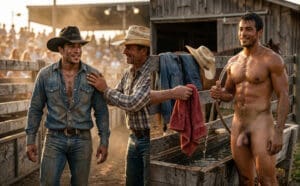
The Favourite carries this fantasy most directly right now — an outlaw favourite, a rodeo entry, a Brazilian fazenda setting, each one working gay cowboys from a different angle of the same territory. Wild Male Encounters reaches the same isolation from a completely different landscape: five Western castaways and the men who already live on their island, the same all-male seclusion that built the historical cowboy fantasy in the first place, just relocated from a bunkhouse to a shore nobody else can reach. Between the two, gay cowboys on NUBRONZE runs from its most literal expression to its closest structural cousin.