

Here’s the part nobody quite says out loud: looking at a photograph of another man is already an act of voyeurism, whether the scene was staged for the camera or not. Gay voyeur isn’t really a subgenre separate from photography itself — it’s closer to the base condition of the medium, the thing every image already asks of whoever’s looking at it. Pretending otherwise is what let pornography turn the word into a gimmick in the first place, as if secrecy were something a scene could perform rather than something built into the act of watching from the start. Street photography built an entire legitimate tradition on exactly this premise, decades before anyone called it voyeurism. Photographers like Robert Frank, Vivian Maier, and Garry Winogrand spent careers capturing strangers who never knew a camera was on them, unposed moments considered some of the most celebrated work photography has ever produced. Nobody calls that tradition exploitative by default. The medium has always understood, at least in its best practitioners, that watching without announcing it is often the only way to catch something real. The first voyeur in any of this is the photographer or filmmaker himself — the reason his work actually lands is that he genuinely loves to look, not merely to document. Caspian says as much himself in Issue 05: images matter because men’s fantasies run on exactly this kind of seeing, a photographer’s own hunger for the moment feeding directly into what a reader eventually wants from the page.
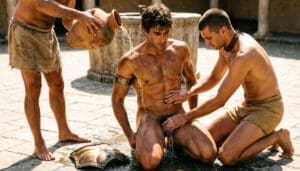
NUBRONZE’s whole standard makes this unusually direct. Embodied eroticism means never photographing a man simply posing for the lens — every image is built around a scene, a moment, a relationship playing out as if the camera weren’t there at all. That choice puts the viewer in a specific position whether he asked for it or not: not the recipient of a performance, but someone watching something private happen. Every image reads as cinematic rather than posed for exactly this reason — a frame pulled from the middle of something, implying a before and an after the picture itself never shows. Pornography voyeurizes the act alone, the sex itself as the entire point of looking. NUBRONZE’s real voyeurism runs earlier than that: catching the moment two men actually started liking each other, the instant attraction crossed over into something neither one could take back, well before anything explicit ever begins. Gay voyeur, on NUBRONZE, isn’t a niche corner of the catalogue. It’s closer to the structural condition the entire catalogue runs on — every series built to be watched, not performed at.

Wild Male Encounters makes the position explicit — men caught mid-labor, mid-rest, mid-desire, never once addressing a camera that, within the story, isn’t supposed to exist. Auction of Prime Males puts the viewer somewhere even more pointed — the alcove sequences exist specifically to be looked at up close, buyers inspecting lots in a scene built entirely around the act of watching. Taking the Photographer carries the premise furthest of all: Joon Park kept shooting after Caspian assumed the camera had stopped, the resulting images gay voyeur in the most literal sense the catalogue has to offer — a moment nobody involved knew was still being watched. Rio Bare Plumes works the same gay voyeur instinct from a candid angle entirely its own — the private half of each diptych catching a dancer backstage, unposed, in a moment Carnival’s crowd never actually saw.