
Heated Rivalries
Felix Garneau spent twenty years photographing athletes without ever once mentioning what he actually saw in a locker room. Heated Rivalries is the reckoning — rival sport after rival sport, competitive men, and a photographer who finally stopped pretending he hadn’t noticed. It’s one of NUBRONZE’s more candid entries in gay sports rivalry photography, and it changed shape halfway through, for reasons the photographer himself doesn’t dispute — an early version that tried too hard, and a later one that trusts the material enough to say less, letting two frames do what four never quite managed.

Twenty Years of Not Saying It
What Garneau Always Saw
Garneau, Montreal-based, Concordia-trained, has shot professional sport across five continents for two decades. He knows what a locker room smells like after a game, which athletes hold eye contact a beat too long, which ones don’t look at each other at all. Bisexual himself, he’s admitted to fantasizing about a significant number of the men he’s photographed over the years — and to developing, as he puts it, a professional blindness. He saw the desire. He simply hadn’t thought to say so. The two facts, he’s said, are related — the blindness was never entirely blind, just professionally convenient.
The Show That Changed That
What broke that habit was Heated Rivalry, the real Crave television series created by Jacob Tierney and adapted from Rachel Reid’s Game Changers novels — Hudson Williams and Connor Storrie as the two rival hockey players who become lovers, François Arnaud rounding out the leads. Garneau wasn’t surprised by what the show revealed. That was the problem. Twenty years of sports photography had already shown him versions of the same dynamic dozens of times, and half a continent was suddenly amazed by something he’d always known. Heated Rivalries, the gallery, is what happened once he stopped staying quiet about it. He’s put it plainly: he isn’t an activist, just a sports photographer who finally stopped pretending he hadn’t noticed.
Two Formats, One Reckoning
The Original Format, and What NUBRONZE Said
The original format paired one large-format confrontation portrait per sport with a three-image frieze underneath — a kiss, a sexual encounter, a rest — repeated identically from one sport to the next. NUBRONZE said so plainly in Issue 04: the device was too heavy, and Garneau had been lazy with it. Sport after sport of the same structure, no variation, no surprise, a curatorial failure from a photographer experienced enough to know better. Partway through, the review noted, a reader was doing arithmetic instead of looking — the exact opposite of what twenty years of photographing bodies should have taught him to avoid.
Sharper the Second Time
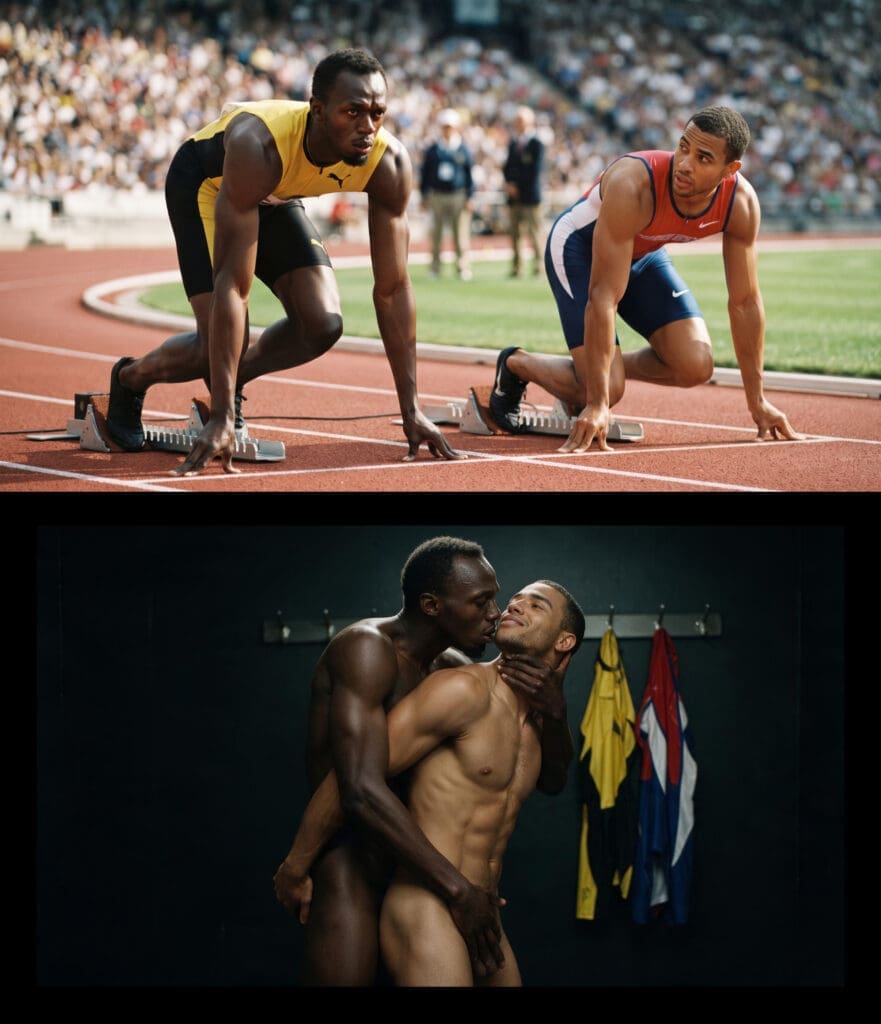
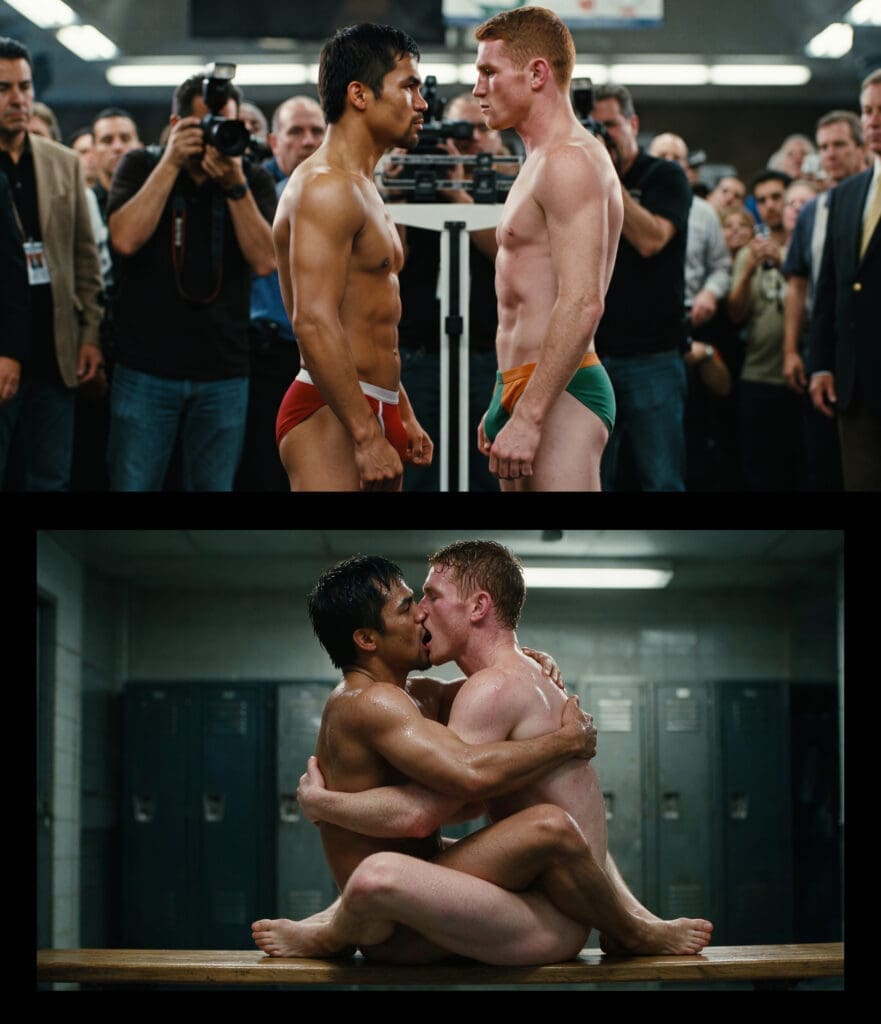
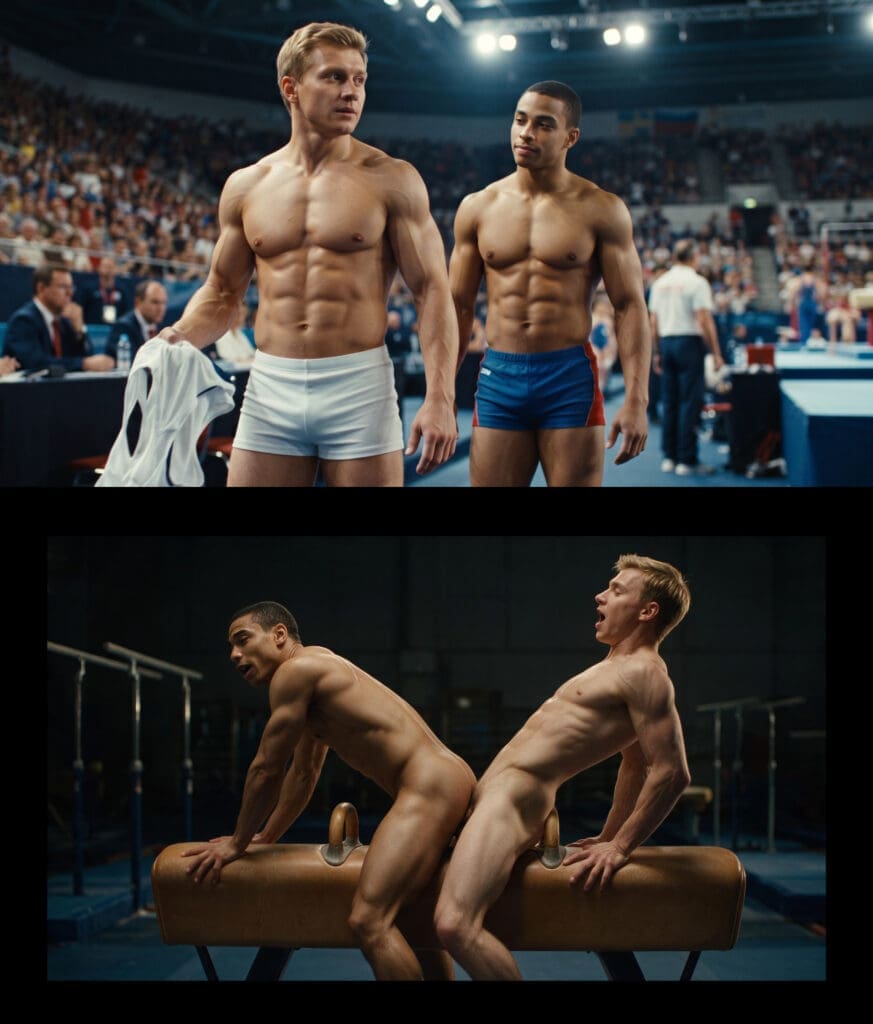
Garneau changed gears. The later entries in this piece of gay sports rivalry photography drop the fixed formula for a tighter diptych — two frames instead of four, no frieze, no repeated architecture forcing every sport into the same box. It’s a clear improvement. The earlier quadriptych era still exists inside the full collection, but it isn’t what earns the series its place here. Fewer moving parts per sport, and each one landing harder for it. A few entries push the format further: the image built around wrestlers and the one built around rugby league players both hold the two rivals in nearly identical positions across both frames — the same pin, the same clinch, repeated. Everyone already suspected the wrestling pin and the rugby clinch carried something sexual underneath the sport. Here it’s made completely explicit: strip the kit away and nothing separates the sports photo from the sex photo but the uniform itself. The gymnasts find the same intensity somewhere else entirely — the pommel horse turning their coupled bodies into pure geometry, an effect the polo players find on horseback instead. The diptych itself is doing the same narrative work here as in The Favourite — two frames carrying a complete story neither one tells alone.
What Actually Works
Rivalry as a Language
What NUBRONZE praised without reservation, even inside a mixed review, was the large portrait work — twenty years of reading competitive male display finally given full attention, and none of it wasted. The braced muscles, the set jaws, the eyes especially: rivalry photographed not as aggression but as a language two men speak fluently, wanting to destroy each other and communicating something else entirely in the process. At full scale, this side of gay sports rivalry photography makes a presence in the room that a smaller print simply can’t manage. The second frame of each diptych carries that same instinct into the coupling itself — Garneau shoots the sex the way he shoots the sport, tracking muscle, leverage, and the mechanics of a good position rather than reaching for a softer, more romantic register. The same competitive intimacy runs through MMA Sparring Partners, from an entirely different sport.
Kisses That Fight Back
The other thing that stopped NUBRONZE cold, more than the explicit material, was the kissing. Garneau shoots a kiss the way he shoots a match — every mouth trying to dominate, every mouth also wanting to be overwhelmed, none of the tenderness romantic photography usually trades in. These are competitive kisses, an extension of the rivalry rather than a break from it, and they’re the images that actually justify calling any of this heated. They also explain, more than anything else in the collection, what the real Heated Rivalry was actually getting at underneath the plot — that on-ice hostility and off-ice want were never really two separate things, just two speeds of the same current.
Why does this series use two different formats?
The series changed partway through. The first sports used a large portrait plus a three-image frieze, a formula NUBRONZE criticized as repetitive from one entry to the next. Garneau moved to a tighter two-image diptych afterward, and this page previews only that later, stronger phase — the quadriptych era still exists in the full collection, just not here.
Are Felix Garneau and the athletes he photographs real?
Garneau is a fictional NUBRONZE photographer, credited openly as invented. The athletes in the series are equally fictional — no real competitor or team is depicted.
Is Heated Rivalry, the TV series, connected to Garneau?
No — it’s a real Crave series, created by Jacob Tierney and based on Rachel Reid’s novels, unconnected to Garneau. It’s simply what pushed Felix Garneau to finally publish what he’d always noticed.
Does this series show explicit sex?
Yes — full nudity and sexual content run through this gay sports rivalry photography, alongside the kissing NUBRONZE singled out as its strongest material. Garneau shoots the sex itself the same way he shoots the sport: muscle, leverage, and good positioning over softness.
Why did Garneau change the concept?
NUBRONZE's Issue 04 review called the original quadriptych format repetitive and too heavy across this gay sports rivalry photography, while praising the large portraits and the kisses specifically. Garneau took that criticism seriously and moved to a tighter diptych for the rest of the series.